
Apple is turning Siri into an AI marketplace; it is positioning iOS as the gateway through which every major AI company must compete for users.
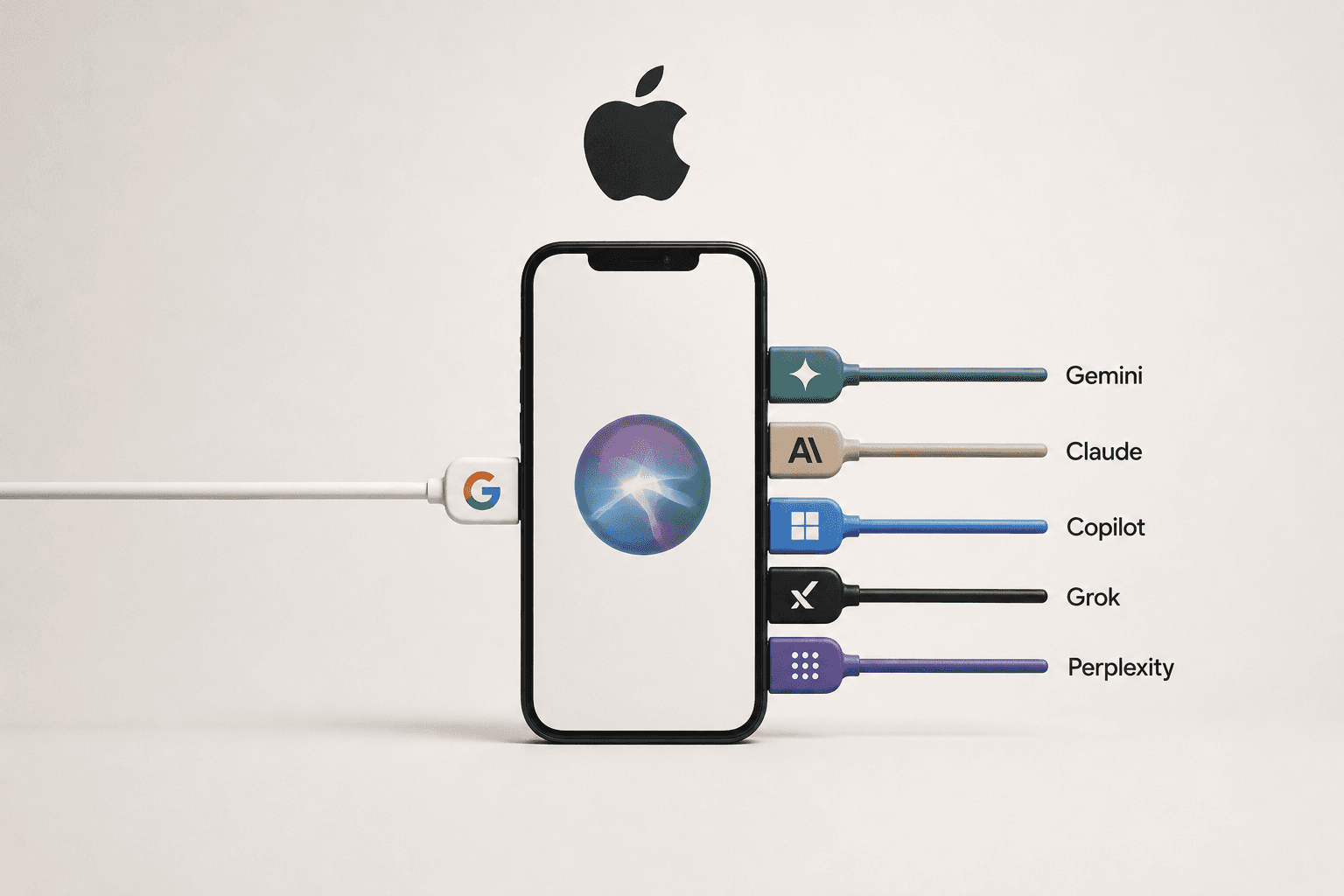
Mark Gurman of Bloomberg announced on March 26 earlier this year that Apple is ending OpenAI’s exclusive deal with Siri and is now introducing an “Extensions” system that allows any third-party AI chatbot, such as Gemini, Claude, Copilot, Grok, or Perplexity, to work directly with Siri. The formal announcement is expected to take place at Apple’s Worldwide Developers Conference on June 8, 2026.
This announcement will declare a considerable change in how Apple places itself within the AI industry, and understanding why requires understanding how Apple arrived here in the first place. Apple's initial deal with OpenAI was depicted as helping Siri handle complex questions that Apple’s own models could not yet handle, with ChatGPT becoming the sole external AI for the iOS version at the time. However, there was disagreement regarding this decision. Apple’s former AI chief, John Giannandrea, had actually desired a deal with Google from the beginning. Eventually, after failed promises about Siri improvements, Apple and Google reached a $1 billion deal in which Google’s Gemini models will power the core of a rebuilt Siri. Apple also replaced Giannandrea with Amar Subramanya, a former Google and Microsoft executive, as its new VP of AI. These two events indicate that Apple had concluded it could not achieve its AI-related goals through solely its own internal development. This is important for the upcoming Extensions announcement: Google formulates the foundational layer powering Siri's primary capabilities, and Apple's Extensions system allows users to use specific AI models as they please.
Prior legal-related situations involving these types of decisions warrant examination because they partially reveal the incentive behind Apple's choice. In 2025, xAI sued Apple and OpenAI, alleging that the deal was an antitrust violation that restricted AI services from achieving fair distribution on Apple devices. In addition, Google has been involved in its own antitrust case over its practice of paying companies, including Apple, billions of dollars for default search placement and ultimately to solidify a monopoly-like position in the industry. Apple's new Extensions system, which opens Siri to all AI models rather than using one exclusively, eliminates these legal issues. Thus, Apple's choice to produce the Extensions model is not just a business decision but also a legal one.
There is a financial dimension to this approach that makes it particularly rational for Apple. OpenAI raised $110 billion in February 2026. Anthropic raised $30 billion the same month. Amazon, Microsoft, Alphabet, and Meta are collectively guiding toward approximately $700 billion in AI-related capital investment in 2026 alone. Apple’s AI-related investment in fiscal 2025 came in at $12.7 billion—down 19 percent year-over-year—with 2026 projections around $14 billion. Apple is not competing in the same financial weight class as its peers in AI infrastructure. For this reason, it is not attempting to do so. Rather than spending the tens of billions required to develop its own model, Apple pays Google $1 billion annually for access to one, then charges every other AI company for distribution access on top of that. This is a capital-efficient approach. It turns Apple from a participant in the AI arms race into the means by which participants must reach their users.
The consequences for OpenAI could be severe. Although ChatGPT losing its exclusivity does not eliminate it, the loss of that exclusivity forces it into an intense competitive landscape. OpenAI's position as the only AI associated with Siri provided a significant benefit that no other AI company could receive: Apple's distribution capabilities. Under Extensions, OpenAI must compete at the point of the user’s question rather than benefit from being the standard choice. Moreover, since Google’s Gemini will power Siri’s core capabilities at the model layer, Google holds a stronger position than any other provider, including OpenAI. ChatGPT becomes one option among many, and it starts that competition from a weaker position than it held before.
The full resolution of this will not arrive until iOS 27 ships in the fall of 2026, and the future is becoming increasingly clear. Apple is no longer attempting to become an AI company in the model-building sense, but rather the primary means by which users access AI and by which AI companies pay to reach them. The competition in AI is now drastically changing. It is no longer only about who has the most capable model. Instead, it is increasingly about who controls the most valuable means of reaching users at scale. Ultimately, with two billion active devices and the most profitable application market in consumer technology, Apple is positioning itself to win that competition without building a single model of its own.
Next Article

Related Topics