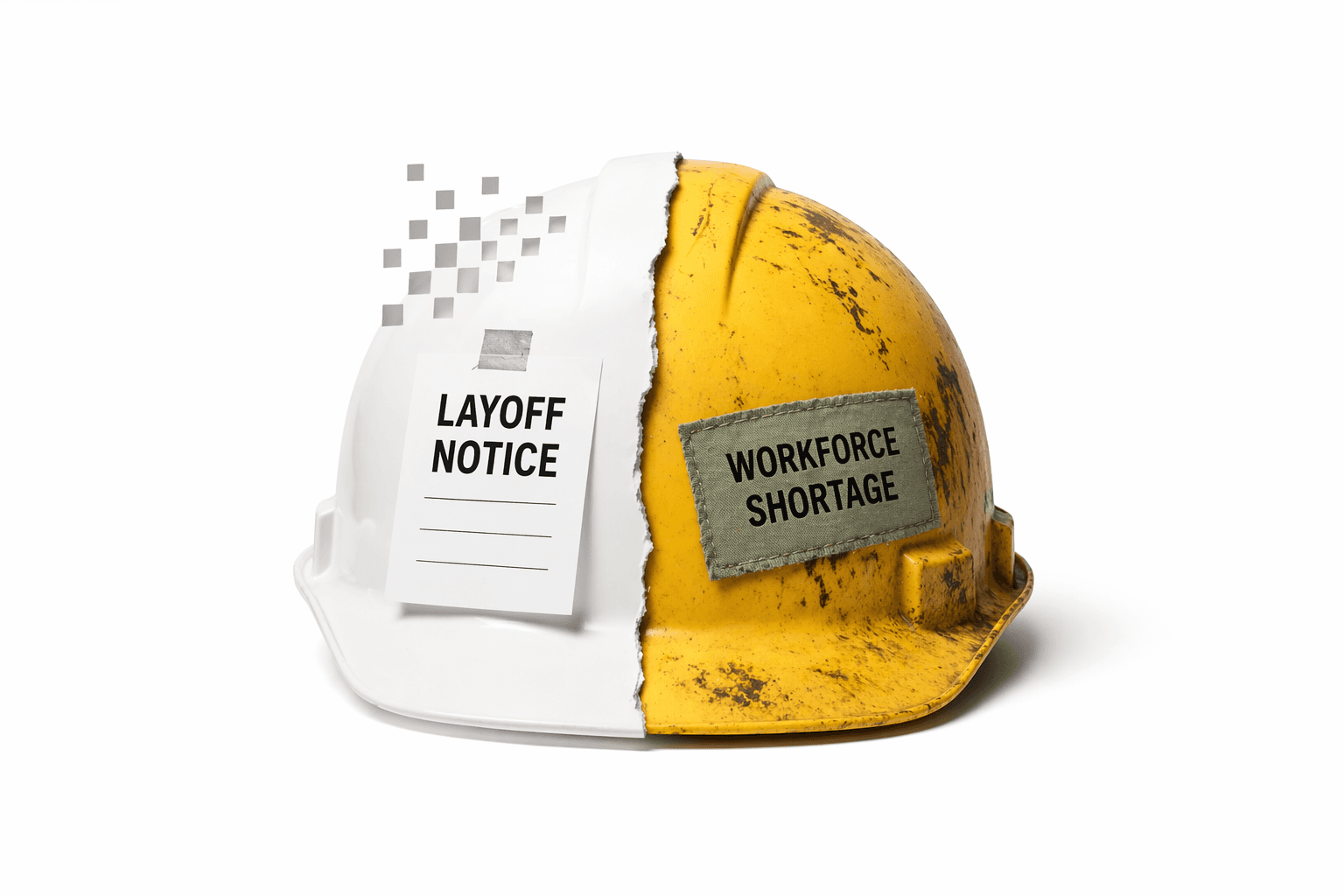
Record-breaking funding rounds for Anthropic and OpenAI mark a new phase in the AI race. With vast sums flowing into compute and scale, the battle is no longer about ideas, but about who can afford to build intelligence first.
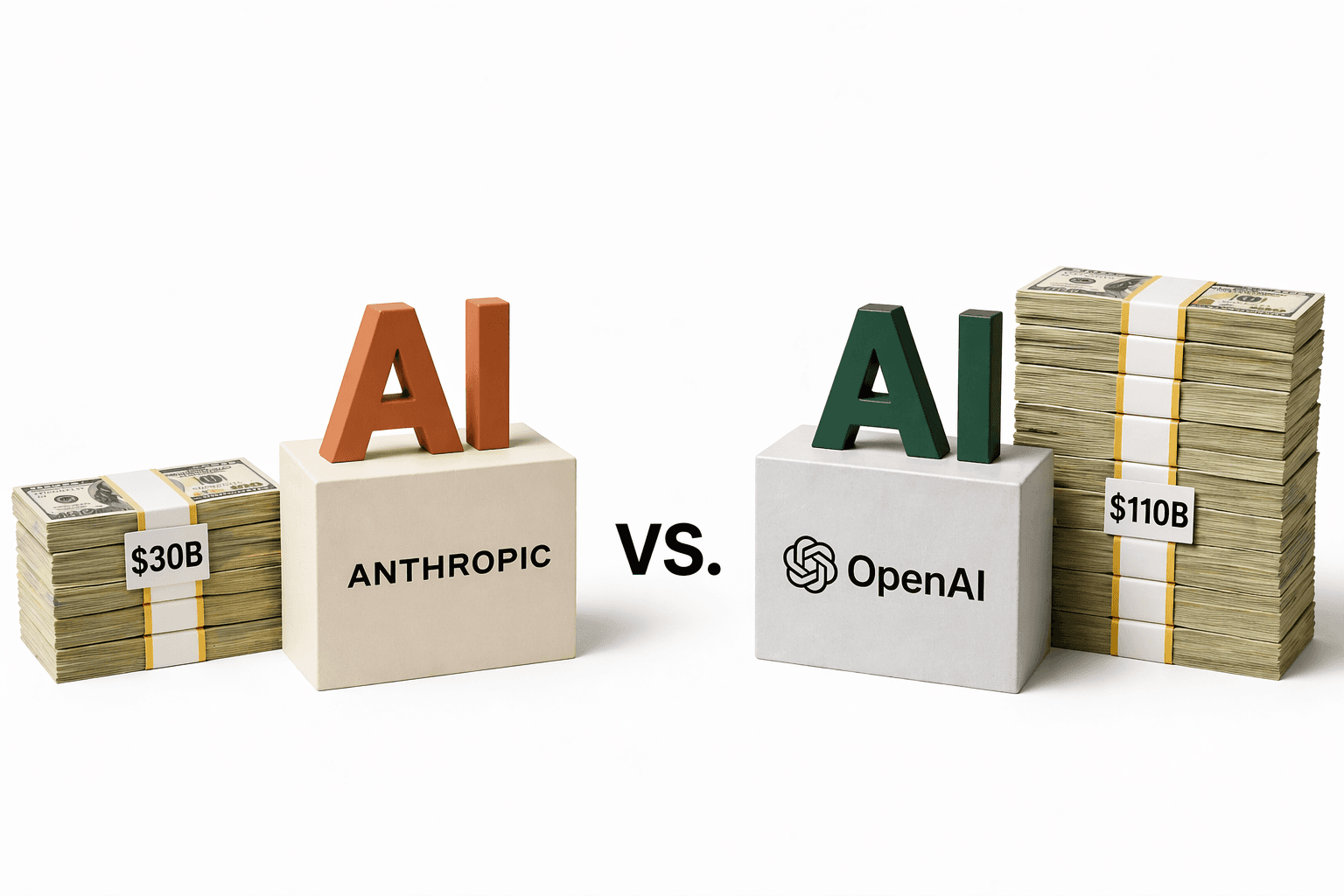
Anthropic raised $30 billion in its Series G round on February 12, increasing its valuation from $183 billion to $380 billion. Roughly two weeks later, on February 27, OpenAI announced a $110 billion round, led by $50 billion from Amazon, $30 billion from SoftBank, and $30 billion from Nvidia, at ultimately a $730 billion pre-money valuation. This is the largest private financing round ever. These two historic capital raises establish a dramatic race between the two companies, with one now taking the lead.
It is important to note that AI companies burn cash at a considerable rate for two main reasons. First, training intelligent AI models requires numerous large GPU (Graphics Processing Unit) clusters to handle computational training and neural networks. Second, scaling these AI models globally, so they can be used millions or even billions of times daily, is extremely costly.
Anthropic’s 2025 annual revenue is $14 billion, with projections of $26 billion by the end of 2026. In contrast, OpenAI is targeting over $280 billion in total revenue by 2030. Yet, neither company is currently profitable. Their large capital raises indicate strong confidence that the AI market will grow enough to justify their spending. This leads to the conclusion that both companies are aiming for majority control over infrastructure, setting up an ongoing race where market share is the ultimate prize.
Throughout its history, Anthropic has raised numerous funding rounds for this very reason. Since the end of 2024, the company has conducted four large raises—far more than a traditional IPO-bound company, which typically has one or two. The recurring monetary demands of AI development are intense, and because Anthropic is competing directly with OpenAI’s ChatGPT, it must continually return to private markets. Each new version or update of Claude requires greater infrastructure, meaning each funding round must surpass the last. The same applies to OpenAI. Although OpenAI has a first-mover advantage, Anthropic has been steadily closing the gap, prompting both to seek increasing amounts of capital.
Recently, Anthropic has begun collaborating with law firm Wilson Sonsini in preparation for a 2026 IPO. At some point, private-market funding will no longer be sufficient to meet its infrastructure demands. OpenAI is also considering an IPO in 2026, but for a different reason: $35 billion of Amazon’s $50 billion investment is contingent on OpenAI going public. As a result, OpenAI is structurally incentivized to pursue an IPO to secure its full funding round.
One effective way to analyze which company leads this race is through Peter Thiel’s seven questions from Zero to One: engineering, timing, monopoly, people, distribution, durability, and the “secret.”
In terms of engineering, both companies are strong, with advanced models like Claude and GPT-5.4. Their differences lie mainly in behavioral nuances. Both also meet the timing criterion, expanding rapidly alongside AI adoption—they are neither too early nor too late.
The companies begin to diverge on monopoly. OpenAI benefits from a first-mover advantage, reaching approximately 900 million users. However, Anthropic holds a stronger position in the enterprise market, with about 40% market share. This segment accounts for roughly 80% of its revenue.
Both teams are highly capable and share similar origins—Anthropic founders Dario and Daniela Amodei previously worked at OpenAI. Cultural differences distinguish them more than talent. Distribution remains unclear due to overlapping partnerships: Microsoft is closely aligned with OpenAI but did not participate in its latest funding round, while Amazon is closely tied to Anthropic yet has heavily invested in OpenAI.
Regarding durability, AI models are gradually becoming commoditized through enterprise distribution, while competitors like Google’s Gemini continue improving. The “secret” lies in differing philosophies: Anthropic prioritizes safety, betting that stricter regulation will favor its approach, while OpenAI bets on scale and brand recognition compounding over time.
While Anthropic performs well under Thiel’s framework, OpenAI ultimately scores higher—primarily due to durability. Google’s planned $185 billion in capital expenditures and the rapid progress of open-source models increase competition. However, OpenAI’s larger valuation and significantly greater funding provide it with stronger long-term stability.
Ultimately, this race will likely shape a new AI landscape with two tiers. At the top will be Anthropic and OpenAI, controlling the majority of market share. The lower tier will consist of other companies that either get absorbed or specialize in niche markets. With the exception of Google, most competitors will struggle to secure comparable capital in private or public markets.
Anthropic’s 2026 IPO will likely be one of the most closely watched public offerings ever, given the global importance of AI. Combined with Amazon’s conditional $35 billion investment in OpenAI, this suggests that both companies may transition to public markets sooner rather than later.
In the end, the winner of this AI arms race will be the company that secures the most funding and deploys it most effectively. However, one conclusion is already becoming clear: OpenAI is currently in the lead.