Leveraged buyouts thrive on predictability. Video games do not. EA’s $55 billion take-private deal forces one of the most creatively volatile industries to operate under one of the most financially rigid ownership structures.
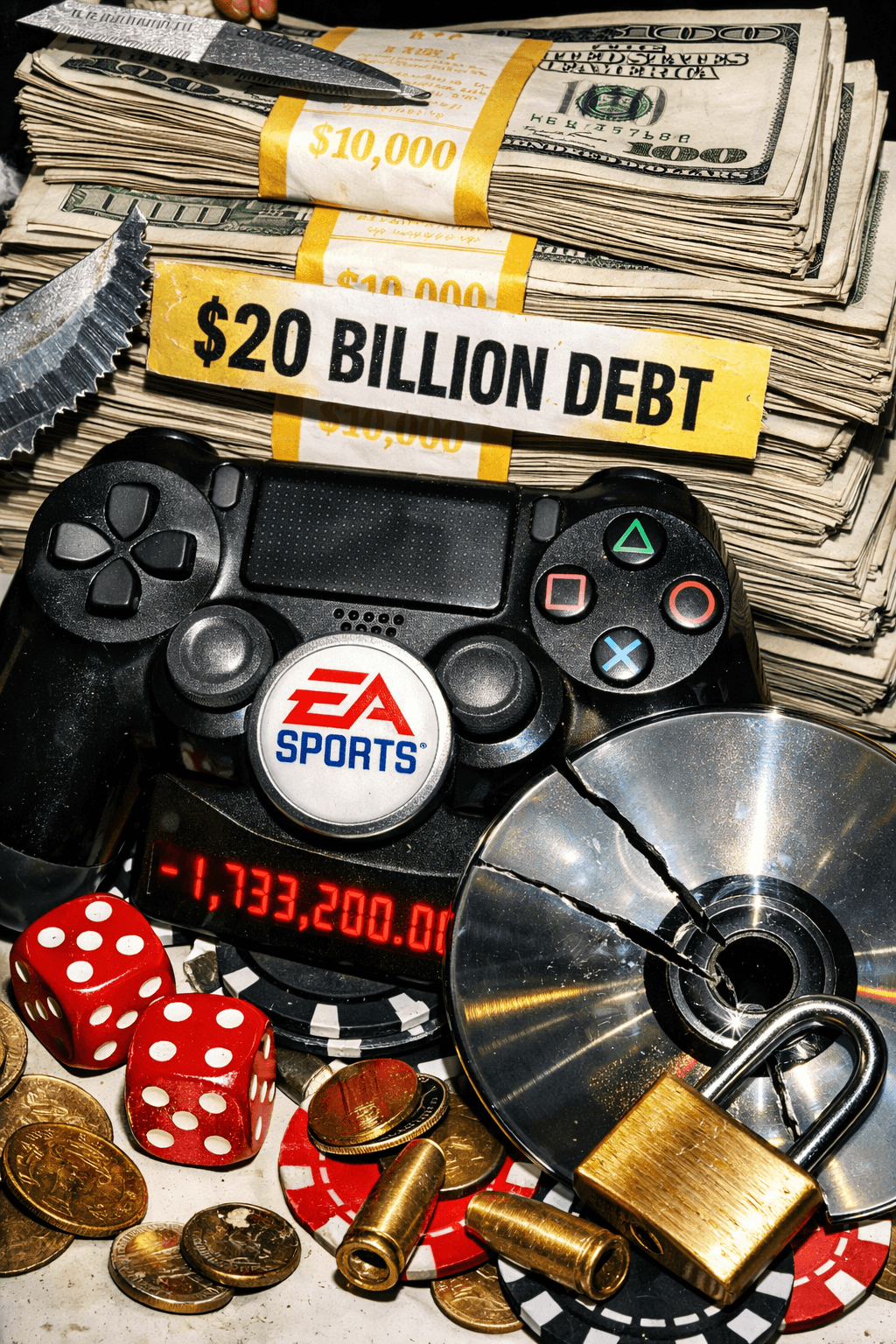
Leveraged buyouts are built for predictability, while video games are built on risk. Success depends on long development cycles and hits that cannot be engineered on a spreadsheet. EA’s $55 billion take-private deal brings these two worlds into direct conflict, pairing one of the most capital-intensive creative industries with one of the most financially rigid ownership structures. With $20 billion of debt layered on top, the transaction raises a central question: can a company known for long-term franchise building innovate under the constant pressure of debt servicing? The answer will determine whether this deal becomes a landmark success or a cautionary tale.
The acquisition of Electronic Arts (EA), announced on September 29th 2025, is the largest leveraged buyout (LBO) in entertainment history. The deal, which is expected to close mid-2026, is driven by a consortium of investors led by Saudi Arabia’s Public Investment Fund (PIF) alongside Silver Lake and Affinity Partners. This all-cash transaction will see shareholders receiving $210 per share, valuing the company at $55 billion. This implies a premium of 25% over its current market cap of $51.12 billion. Once the deal is finalized, EA will no longer be traded publicly and its shares will be taken off the stock market. For shareholders, the deal offers a clean exit at an attractive valuation. For the buyers, it is a high-conviction wager on the long-term economics of gaming and intellectual property (IP).
Before the acquisition announcement, the company was profitable, with a gross margin of 79.3%. It also had strong cash flow generation, with approximately $1.9 billion in free cash flow (as of Q3 2025). More importantly, it was anchored by some of the most popular franchises in gaming history, such as FIFA (now FC), Madden, Apex Legends, and The Sims. A growing share of EA’s revenue came from subscriptions and in-game purchases, providing recurring and relatively predictable cash flows. Despite this, EA’s stock price has stayed mostly flat during the last couple of years. This was mainly due to rising development costs, and the broader gaming sector faced post-pandemic normalization after explosive demand. Public investors were getting impatient and were extremely skeptical of long-term upside. Against this backdrop, private capital saw an opportunity. The all-cash deal means shareholders receive immediate liquidity with no exposure to post-transaction risk. However, the deal is financed through roughly $20 billion in debt, which will go straight onto EA’s balance sheet, creating the deal’s primary financial risk.
From a financial perspective, the headline number might seem shocking but it’s not irrational when compared to historic M&A deals. The deal price of roughly 19.6x EBITDA falls within the range of comparable transactions, such as the Microsoft/Activision deal, which was valued at 20.2x EBITDA. However, the price is rich compared to profitable public peers. EA traded at a 59.7x P/E ratio before the deal, while Nintendo trades closer to 32x.
From a pure transaction standpoint, the deal rationale is defensible for both sides. For EA, going private allows CEO Andrew Wilson to remain in charge and focus on long-term IP development for games such as Battlefield and The Sims, without facing pressure from public investors about profits and returns. This is particularly relevant in gaming because a single successful title can take years to develop and monetize. Specifically, EA's management wants to rebuild the Battlefield franchise from the ground up, a multi-year project they believe can only happen away from public scrutiny and the short-term demands of quarterly earnings reports. This strategic pivot is necessary if they want to outperform rival gaming franchises like Activision’s Call of Duty, which has more available funding and earlier market entry. For the PIF, which will hold approximately 93.4% of EA's equity, this deal aligns with the ‘Saudi Vision 2030’, integrating EA’s IP into the Kingdom’s emerging gaming and esports ecosystem. The consortium aims to leverage EA’s IP into broader media such as film, TV, and physical events, something that is easier to do under a single, private ownership structure rather than a public one. These synergies, while ambitious, depend heavily on execution and consumer acceptance of Saudi-branded gaming experiences.
That said, there are several risks associated with this deal. The biggest being the $20 billion debt burden. While EA generates strong cash flow, the leverage ratio is aggressive even by LBO standards. The pressure to service this debt will almost certainly lead to continued workforce reductions and studio closures. Additionally, despite promises to protect creative freedom, the heavy debt from the deal will likely push EA to focus on financial performance rather than creative risk. Assuming the $20 billion in new debt and EBITDA of roughly $2.8 billion (based on recent figures), the transaction implies a leverage ratio higher than 7x. At an estimated 8-9% interest rate, EA faces annual debt service obligations of approximately $1.6-1.8 billion, consuming nearly all of its current free cash flow and leaving minimal capital for reinvestment or creative risk-taking. Furthermore, operational synergies are minimal because unlike a standard merger, there are no duplicate teams or management to lay off in order to reduce costs. If the upcoming Battlefield relaunch fails to capture 10 million active users in year one, EA could face a $1 billion write-down, ceding the market permanently to competitors like Call of Duty. This high leverage ratio means EA must maintain free cash flow margins above a critical 25% threshold to comfortably service debt. Dipping below this would risk a breach of debt covenants.
Based on the analysis of the deal, there are three possible scenarios: the best case, base case (most likely), and worst case. In the best case, private ownership allows EA to take more risk and unlock their creative potential. The current redevelopment of Battlefield and future releases become major hits, and the company IPOs again in 5-8 years at a $80 billion valuation. More likely, however, the debt forces aggressive cost-cutting, studio sales become necessary, and EA operates as a profitable but creatively constrained company. In the worst case, key talent leaves due to cultural clashes and debt pressure, major game launches fail, and the consortium is forced into a messy restructuring of assets. Given the three possible scenarios, the consortium likely overpaid, valuing EA not purely on financial fundamentals but on strategic and political considerations that inflate the multiple beyond what cash flows alone would justify.
The verdict ultimately depends on what success means. If the goal is financial return, the 7x leverage and modest operational synergies make this a questionable bet. If the goal is geopolitical influence and cultural positioning, the price may be justified regardless of financial performance. Ultimately, this deal will succeed only if management can achieve unprecedented operational efficiency while simultaneously fostering radical innovation in EA’s upcoming games, a highly unlikely scenario given the inherent pressure of an LBO.