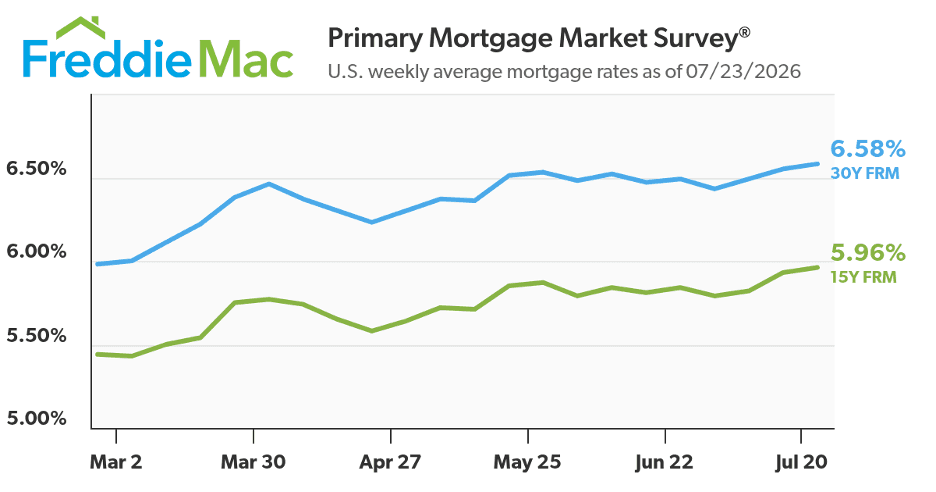
Mortgage rates have climbed even as the Fed has held its benchmark rate steady.

Interest rates on 15- and 30-year mortgages are sitting about 60bps higher than at the end of February. Yet, in June, the Fed shakily voted 9-3 to keep the Effective Funds Rate steady, with Fed presidents divided on whether or not to raise rates or keep them steady. Whether or not the Fed does end up raising rates is highly dependent on the cost-push inflation implications of the prolongation of the Iran war, leading some investors to price in a rate hike before the end of the year. While the Fed bases its decisions for rates on core PCE inflation, which excludes the effects of energy price hikes, it is clear that the current crisis has follow-on effects throughout the economy, and the key to it is the mortgage market.
Duration is a measure of how long it takes for an investor to receive all the cash flows from a fixed-income security, weighted by the present value of each cash flow. For standard coupon bonds without callable options, when yields increase (e.g., due to higher interest rates), the bond's price will decrease, as investors will want to reinvest at higher current yields. Thankfully, it’s not all bad for the fixed-income investor in this instance: For simplicity, let’s say annual interest on an uncallable bond sits at 3% and therefore pays a .25% coupon every month. Then interest rises to 6% on this particular product. All cash flows are worth less than before, but the coupon in month 1 is worth less than the coupon in month 11. So while the PV of month 1 is worth exactly half of the bond at the current yield, the PV at month 11 is worth much less because investors have had a chance to reinvest all previous cash flows into higher-yielding products. This shortens the duration by allowing investors to receive the majority of the PV of their investment earlier, to be reinvested. This way, an increase in yields leads to a decrease in duration for this security. We call fixed-income securities with this characteristic positively convex.
This is not the case for mortgages, however, as most mortgages can be refinanced at any time. There is some prepayment expected with any mortgage as people can get a larger-than-expected bonus, win the lottery, or they move houses, which results in an interest-rate-unrelated refinancing. This prepayment risk is embedded in the expected duration of the mortgage. However, when yields rise, or are expected to rise, this duration extends as fewer homeowners refinance and put money aside for pre-payments. If yields rise high enough due to increased interest rates, some sophisticated consumers may invest extra money they would have used to pay off their mortgage into fixed income products that produce higher interest than their mortgage (although this is less likely due to the discrepancy in interest rates households face as a borrower versus a lender). This is bad for mortgage investors, as consumers put aside less money to pay down their mortgages when interest rates rise, leaving mortgage investors stuck with lower-yielding assets for longer. Because duration increases when yields increase, mortgages and, hence, their bundled security, mortgage-backed securities, are said to be negatively convex.
Therefore, as interest rate hikes are anticipated, as is the case right now, investors in mortgages/mortgage-backed securities demand higher interest rates as compensation for this perceived duration risk. This demand for higher compensation is passed on to mortgage buyers in the form of higher interest rates amid hawkish Fed action. As inflationary pressures from the war continue to accumulate in the coming months, investors in long-dated callable securities will continue to demand higher compensation, increasing costs for borrowers.