
Hg Capital’s $6.4bn take-private of OneStream exposes a market disconnect: public investors punished short-term losses, while private equity saw long-term dominance in CFO software. What looked like weakness became a bargain for patient capital.
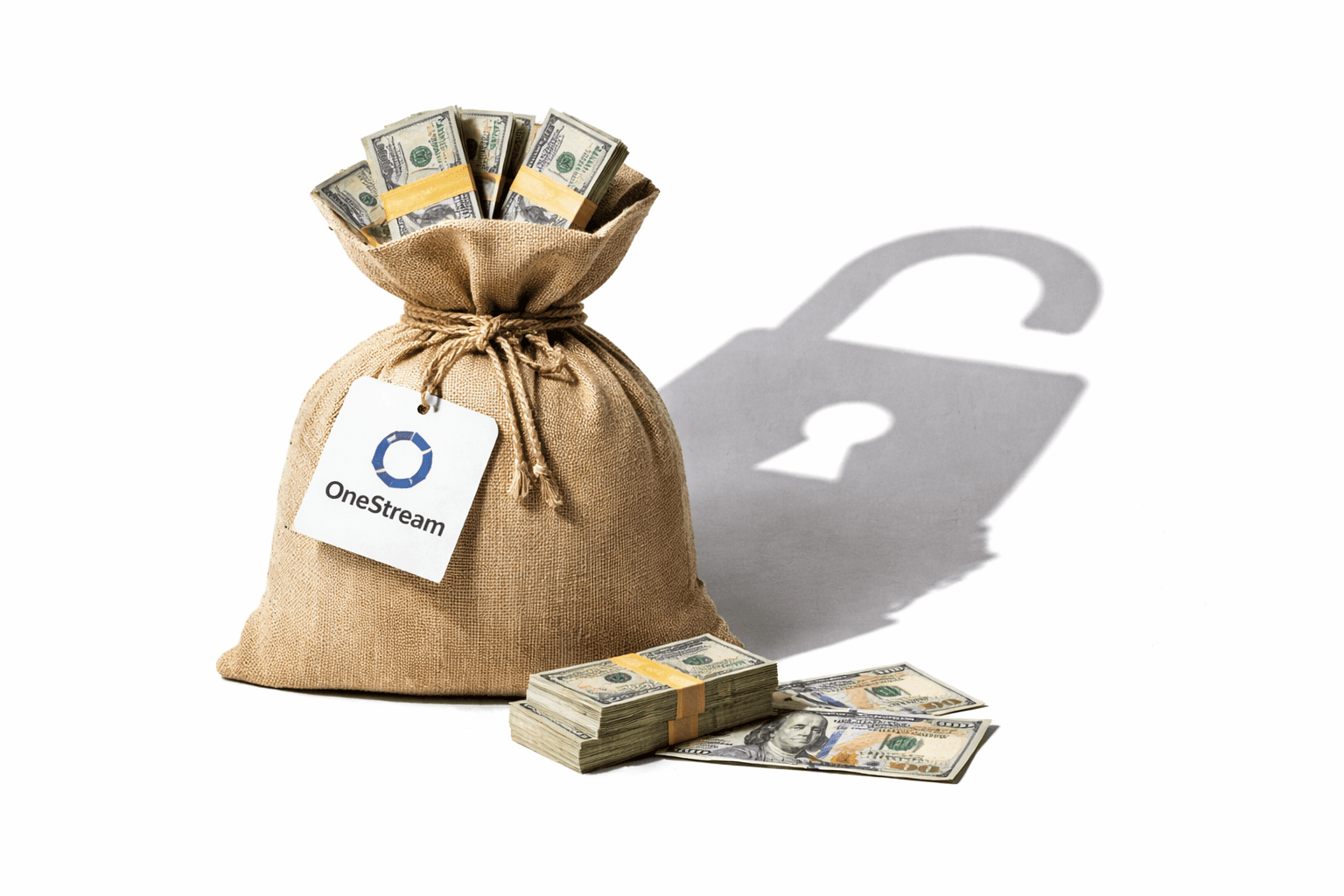
In July of 2024, OneStream joined the public market with a price tag of $20 and a promise to automate the "Office of the CFO". A year and a half later, it is already leaving through the back door and escaping from the public eye. They are doing this through Hg Capital’s $6.4 billion take-private acquisition, which isn't just a regular acquisition; it’s a heist. While public investors were busy panicking over quarterly losses, private equity recognized a future monopoly in financial software—acquiring a generational asset at a 30% discount to its private peak. This transition reflects a disconnect: the public market struggled to value OneStream’s long-term potential against its short-term costs.
To understand why OneStream’s public life was so short-lived, you have to look at its birth. The company’s S-1 filing revealed a "Synthetic Secondary" structure. Unlike a traditional IPO where a company raises funding to build products, a massive portion of OneStream’s proceeds went toward buying out units from KKR and CEO Tom Shea.
This structure signals to public investors that those with the most internal knowledge are looking for an exit. The underwriters of the deal, Morgan Stanley and J.P. Morgan, priced the IPO at $20.00, but the stock immediately surged to $33.00, a 65% increase that created an unsustainable valuation. When actual earnings could not justify this inflated price, the stock began a steady decline. Hg Capital was able to capitalize on this downward momentum and acquire OneStream for $24.00 per share, a price only slightly above the original IPO level but still 27% below its post-IPO peak.
In 2025, public market sentiment shifted to prioritize immediate profits and positive quarterly earnings over long-term revenue growth. OneStream ended 2025 with $601.9 million in revenue, representing solid 23% year-over-year growth, but the company also reported a $94.8 million operating loss.
Public investors simply could not look past these losses. For Hg Capital, however, they were an opportunity. The losses were largely driven by $115.4 million in stock-based compensation and heavy investment in their SensibleAI platform. By taking the company private, Hg can eliminate the high administrative costs of being a public entity and continue developing its AI specialized for finance without the pressure of public scrutiny and short reporting cycles. What the public saw as poor performance through bad earnings, Hg saw as long-term growth through spending on innovation.
OneStream’s market value dropped significantly from its $9 billion+ private peak in 2022 to roughly $6 billion in early 2026. To put this in perspective, when Thoma Bravo acquired Anaplan (OneStream's closest competitor) in 2022, they paid $10.7 billion, which was a 17x revenue multiple.
Hg is acquiring OneStream (a superior, unified platform) at a 10.7x revenue multiple. While this is a 31% premium over its recent public price, it is a massive discount compared to the multiples paid for a similar company just years ago. Hg is essentially leveraging the public market's profitability fatigue to acquire a potentially generational software asset at clearance price.
To further understand Hg’s rationale for this acquisition, it’s important to look at OneStream’s strategic market positioning as the “operating system for the modern CFO”. The company’s primary strength lies in its unified codebase, which provides a seamless experience compared to the fragmented tools offered by legacy competitors like Oracle and SAP. This structural advantage has led to a customer retention rate exceeding 95% and a client base that already includes 18% of the Fortune 500. However, the business faces notable weaknesses as well, including high implementation complexity and a revenue footprint that remains heavily focused on the United States.
The opportunities that come out of this deal center on Hg Capital’s status as the most prominent software investor in Europe. By taking OneStream private, Hg can greatly bolster the company’s European presence while developing its innovative financial AI away from the scrutiny and pressure of quarterly earnings calls. This transition makes it so that OneStream can finalize its international scaling and technical innovation on a timeline that the public market was too impatient to support.
The acquisition is a heist in plain sight; it will succeed because OneStream can now achieve its next stage of growth shielded from the public market's 90-day myopia. Hg Capital is paying for quality, but they are getting it at a steal compared to OneStream's true potential.
This take-private deal reflects a broader market sentiment. OneStream’s departure is a warning: If the public markets continue to value safe cash flow over actual innovation, the best technology will continue to retreat into the shadows of Private Equity. In the end, OneStream didn't fail the market; the market failed to see the value in OneStream
Next Article

Related Topics