Macroeconomics Chapter 8: Policy Objectives - Balance of Payments
This chapter explores the concept of balance of payments, and the policy objective of stable balance of payments.
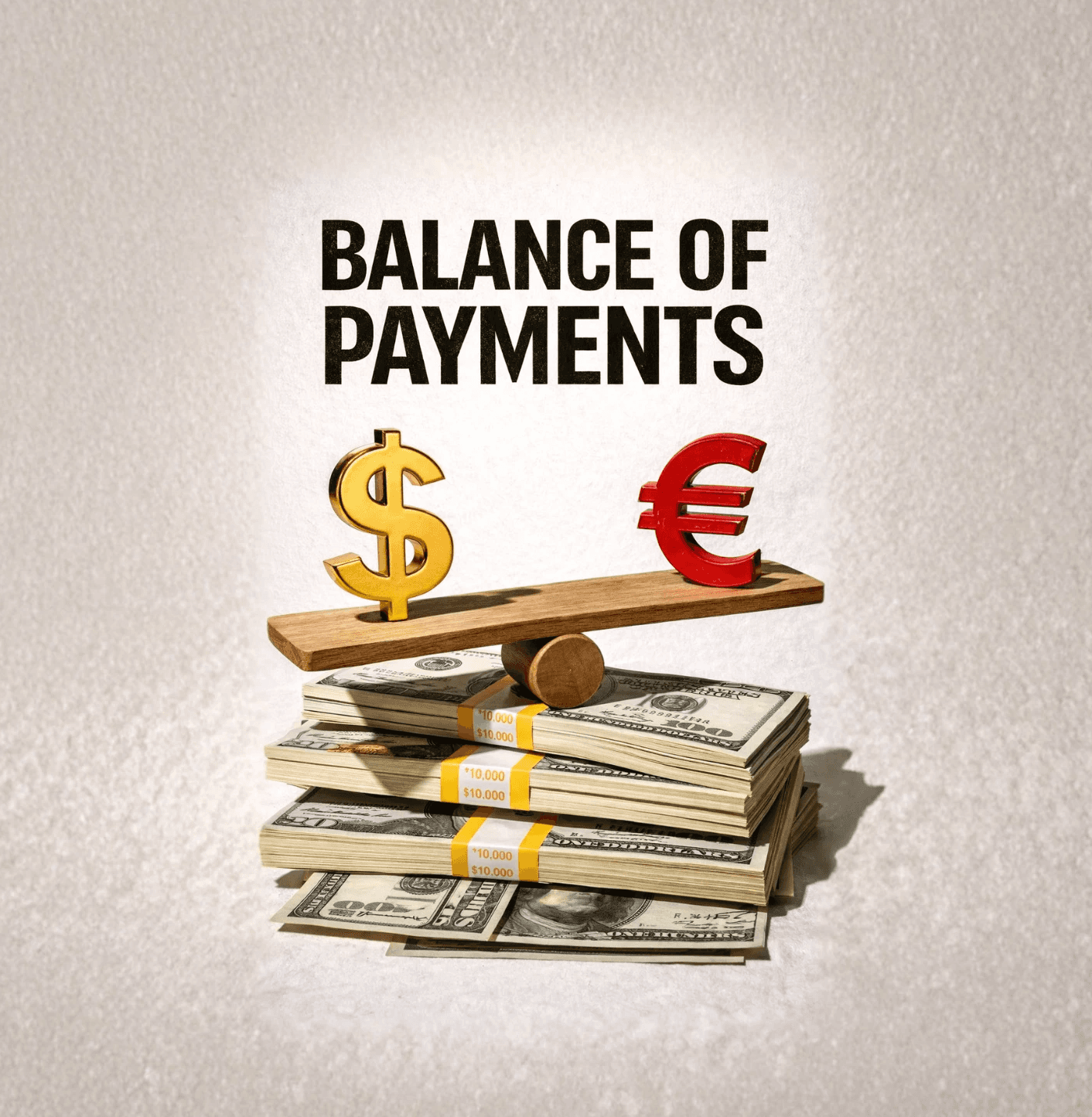
The Balance of Payments
The balance of payments is a systematic record of all economic transactions that take place between the residents of a country and the rest of the world over a given period of time. These transactions arise whenever residents buy from or sell to non-residents, receive income from abroad, make payments to foreign investors, or transfer money across national borders. The balance of payments therefore provides a comprehensive picture of a country’s economic relationship with the global economy.
At its core, the balance of payments is an accounting framework rather than a measure of economic performance. Its purpose is to record transactions accurately and consistently, not to judge whether outcomes are desirable or undesirable. Every transaction recorded in the balance of payments involves an exchange of value and must therefore be entered twice, once as a credit and once as a debit. This double-entry system ensures that the accounts are internally consistent.
A credit item in the balance of payments represents a transaction that brings money into the country. Examples include exports of goods and services, income earned by residents from overseas investments, or foreign investment flowing into domestic assets. A debit item represents a transaction that results in money flowing out of the country, such as imports of goods and services, income paid to foreign investors, or domestic residents purchasing foreign assets.
For example, when a domestic firm exports goods to a foreign buyer, this export is recorded as a credit because it generates income from abroad. At the same time, there must be a corresponding debit entry reflecting how payment is made, such as an increase in foreign bank deposits held by domestic residents or a reduction in foreign assets owned by the country. Similarly, when residents import goods from abroad, this transaction is recorded as a debit, with a corresponding credit entry showing how the import is financed.
Because every transaction gives rise to both a credit and a debit entry, the balance of payments must always balance in accounting terms. This means that when all components of the balance of payments are added together, the total must equal zero. This does not imply that a country’s international transactions are in equilibrium or that trade is balanced. Instead, it reflects the accounting identity that all payments must be financed in some way.
It is important to distinguish between the overall balance of payments and the balances on individual components of the accounts. While the total balance of payments must sum to zero, individual sections of the accounts may show surpluses or deficits. For example, a country may run a deficit on trade in goods and services while simultaneously running a surplus on financial transactions. These imbalances are central to economic analysis and policy debate, even though the overall accounts balance by definition.
The balance of payments plays a crucial role in understanding how a country finances its spending relative to its income. If a country spends more on imports and income payments than it earns from exports and overseas income, it must finance this gap by borrowing from abroad or by selling domestic assets to foreign investors. Conversely, a country that earns more than it spends internationally will accumulate foreign assets or reduce foreign liabilities.
In an increasingly interconnected global economy, monitoring the balance of payments has become particularly important. Changes in trade patterns, capital flows, and income transfers can have significant effects on exchange rates, domestic employment, investment, and economic growth. The balance of payments therefore provides a vital framework for analysing how domestic economic activity is linked to developments in the wider global economy.
The Structure of the Balance of Payments
The balance of payments is divided into a set of distinct but interconnected accounts that classify international transactions according to their nature. This structure allows economists and policymakers to analyse not only the total volume of transactions with the rest of the world, but also the underlying sources of inflows and outflows. Although the overall balance of payments must always equal zero, the individual accounts within it can and often do show substantial imbalances.
In line with international standards, the balance of payments is divided into three main components. These are the current account, the financial account, and the capital account. Each account records a different type of transaction, and together they provide a complete picture of a country’s international economic activity.
The current account records transactions related to the production of goods and services and the generation and transfer of income. It captures flows that arise from trade, employment income, investment income, and transfers that do not involve the exchange of assets. Because these transactions are closely linked to domestic output, income, and living standards, the current account tends to attract the greatest attention in economic analysis and public debate.
The financial account records transactions that involve changes in ownership of financial assets and liabilities between residents and non-residents. These include foreign direct investment, portfolio investment, and other financial flows such as bank lending and deposits. The financial account shows how current account imbalances are financed. For example, a current account deficit must be matched by a surplus on the financial account, reflecting borrowing from abroad or the sale of domestic assets to foreign investors.
The capital account is typically much smaller than the other two components. It records capital transfers and transactions involving non-produced, non-financial assets. These include transfers of ownership linked to migration, debt forgiveness, and the sale or purchase of certain intangible assets. Although the capital account plays a limited role in most economies, it is included to ensure that all cross-border transactions are fully accounted for.
An important feature of the balance of payments structure is that these accounts are not independent of one another. A surplus or deficit in the current account must be offset by corresponding movements in the financial and capital accounts. If a country imports more goods and services than it exports, the resulting current account deficit must be financed either by attracting foreign investment, borrowing from abroad, or reducing foreign assets held by residents. In accounting terms, this financing appears as a surplus on the financial account.
It is therefore incorrect to interpret a deficit in one account as evidence of an error or imbalance in the accounting framework. Instead, such deficits reflect real economic choices and outcomes. A country may deliberately run a current account deficit to finance higher levels of investment, or it may experience a surplus because domestic saving exceeds domestic investment opportunities. The balance of payments structure allows these relationships to be examined systematically.
Although the overall balance of payments must balance, statistical discrepancies can arise in practice due to measurement error, timing differences, and incomplete data. These discrepancies are recorded as errors and omissions. Their presence highlights the difficulty of measuring international transactions accurately, especially in a world of complex financial flows and multinational production.
Understanding the structure of the balance of payments is essential for interpreting international economic data. It provides the framework within which trade balances, income flows, and capital movements can be analysed, and it helps to explain how domestic economic conditions are linked to developments in global markets.
The Current Account
The current account is the most closely watched component of the balance of payments because it records transactions that are directly linked to a country’s production, income, and spending. It shows whether an economy is earning more from its interaction with the rest of the world than it is spending, or vice versa. As such, the current account provides important information about a country’s external position and its reliance on foreign finance.
A surplus on the current account indicates that the value of receipts from abroad exceeds payments to the rest of the world. This means that the country is, on net, a lender to the rest of the world and is accumulating foreign assets or reducing foreign liabilities. A deficit on the current account indicates that payments to the rest of the world exceed receipts, implying that the country is, on net, a borrower and must finance this gap through inflows on the financial account.
The current account is made up of three main components. These are trade in goods and services, primary income, and secondary income. Each component captures a different type of transaction, and together they explain the overall current account balance.
Trade in Goods and Services
Trade in goods and services is the largest and most visible component of the current account. Trade in goods refers to the export and import of physical products, such as manufactured items, raw materials, and agricultural produce. Exports of goods are recorded as credit items because they generate income from abroad, while imports of goods are recorded as debit items because they involve payments to non-residents.
Trade in services refers to the exchange of non-physical products between residents and non-residents. Services include activities such as transport, tourism, financial services, insurance, education, and professional services. As with goods, exports of services are recorded as credits and imports of services as debits.
For advanced economies, trade in services often plays a particularly important role. Even if a country runs a persistent deficit on trade in goods, it may partially or fully offset this with a surplus on trade in services. The balance on trade in goods and services combined is often referred to as the trade balance, and it is a major determinant of the overall current account position.
Trade flows are influenced by a range of factors. These include domestic and foreign income levels, relative prices, productivity, and exchange rates. Strong economic growth at home tends to increase demand for imports, while growth abroad increases demand for exports. Similarly, if domestic goods become less competitive relative to foreign goods, imports may rise and exports may fall, worsening the trade balance.
Primary Income
Primary income records income earned by residents from the rest of the world and income paid to non-residents for their contribution to domestic production. This component includes compensation of employees and investment income.
Compensation of employees covers wages and salaries earned by residents who work abroad for short periods, as well as wages paid to foreign residents working temporarily in the domestic economy. These flows are usually small for large economies but can be significant for countries with high cross-border labour mobility.
Investment income is typically the largest part of primary income. It includes income earned on foreign assets owned by residents, such as profits from foreign direct investment, interest on bonds, and dividends from shares. It also includes income paid to foreign investors who own assets in the domestic economy. If residents earn more on their foreign investments than foreigners earn on domestic investments, the primary income balance will be positive. If the opposite is true, it will be negative.
Primary income can therefore play an important role in shaping the current account balance. A country with a large stock of overseas assets may continue to earn substantial income from abroad even if its trade balance is weak. Conversely, a country that has sold significant domestic assets to foreign investors may face large income outflows in the form of profits, dividends, and interest payments.
Secondary Income
Secondary income consists of current transfers between residents and non-residents that do not involve the exchange of goods, services, or assets. These transfers are one-way payments and therefore directly affect the current account balance.
Examples of secondary income include remittances sent by migrant workers to their families, international aid payments, contributions to international organisations, and government transfers. For many countries, secondary income is in deficit, reflecting net payments to the rest of the world.
Although secondary income is often smaller than trade and primary income flows, it can still be economically significant. In some developing economies, remittances from citizens working abroad form an important source of income and help to finance imports. In other cases, persistent transfer payments can contribute to current account deficits.
Taken together, trade in goods and services, primary income, and secondary income determine the overall current account balance. Changes in any of these components can alter a country’s external position and influence the scale and nature of financial flows required to balance the overall balance of payments.
The Financial Account
The financial account records transactions that involve changes in ownership of financial assets and liabilities between residents of a country and the rest of the world. While the current account records flows linked to production, income, and transfers, the financial account shows how these flows are financed. In particular, it explains how current account surpluses and deficits are matched by movements of capital across borders.
If a country runs a current account deficit, it must finance this deficit by attracting financial inflows from abroad. These inflows appear as a surplus on the financial account. Conversely, if a country runs a current account surplus, it must export capital to the rest of the world, which appears as a deficit on the financial account. This relationship reflects the accounting identity that underpins the balance of payments as a whole.
Transactions recorded in the financial account do not measure income or output directly. Instead, they capture changes in financial claims. These changes can arise because domestic residents purchase foreign assets, foreign residents purchase domestic assets, or because financial positions change through lending, borrowing, or investment.
The financial account is divided into several categories, reflecting different forms of international investment. These categories differ in terms of their motivation, time horizon, and stability, and they therefore have different implications for economic analysis and policy.
Foreign Direct Investment
Foreign direct investment refers to cross-border investment in which an investor acquires a lasting interest and a significant degree of control over a business in another country. This typically involves ownership of at least a substantial share of the firm and participation in its management. Examples include multinational companies establishing subsidiaries abroad, acquiring foreign firms, or expanding existing overseas operations.
Foreign direct investment can flow into a country when foreign firms invest in domestic businesses, or out of a country when domestic firms invest abroad. In the balance of payments, inward foreign direct investment is recorded as a credit on the financial account, while outward foreign direct investment is recorded as a debit.
Foreign direct investment is often regarded as a relatively stable form of capital flow. Because it involves long-term commitments and physical assets, it is less easily reversed than short-term financial investment. It can also bring potential benefits such as access to new technologies, management expertise, and international markets. However, it may also lead to future outflows of income, as profits generated by foreign-owned firms are repatriated to their owners abroad and recorded as debits in the primary income component of the current account.
Portfolio Investment
Portfolio investment involves the purchase and sale of financial assets such as shares and bonds that do not confer control over the issuing firm. Investors engaged in portfolio investment are primarily motivated by expected returns and risk considerations rather than by the desire to influence management decisions.
Inward portfolio investment occurs when foreign investors purchase domestic equities or debt securities, while outward portfolio investment occurs when domestic residents purchase foreign financial assets. These flows can be highly sensitive to changes in interest rates, exchange rate expectations, and perceptions of economic and political risk.
Because portfolio investment can be withdrawn quickly, it is often more volatile than foreign direct investment. Sudden changes in investor sentiment can lead to large and rapid movements of capital, which may place pressure on exchange rates and financial markets. For this reason, portfolio flows are closely monitored by policymakers, particularly in economies that are heavily reliant on foreign capital.
Other Financial Flows and Reserve Assets
In addition to direct and portfolio investment, the financial account includes other financial transactions. These include cross-border bank lending and borrowing, changes in deposits held abroad, and transactions involving financial derivatives. Such flows can be large and complex, reflecting the integrated nature of global financial markets.
The final category within the financial account is reserve assets. Reserve assets consist of foreign currency reserves, gold, and other internationally accepted means of payment held by the central bank. Changes in reserve assets reflect official intervention in foreign exchange markets or deliberate policy decisions to build up or run down reserves.
In economies operating under floating exchange rate systems, transactions in reserve assets are typically less frequent than under fixed exchange rate regimes. However, reserve assets still play an important role in maintaining confidence and providing a buffer against external shocks.
The financial account therefore provides crucial insight into how countries interact with global capital markets. By examining the composition and direction of financial flows, economists can assess the sustainability of current account positions and the potential risks associated with reliance on foreign finance.
The Capital Account
The capital account is the smallest and least prominent component of the balance of payments, but it plays an important role in ensuring that all cross-border transactions are fully recorded. It captures transactions that involve the transfer of assets rather than ongoing production, income, or financial investment. Although the capital account is usually small relative to the current and financial accounts, it completes the overall accounting framework.
The capital account records capital transfers and transactions involving non-produced, non-financial assets. Capital transfers differ from current transfers because they are linked to the acquisition or disposal of assets or to changes in ownership that affect a country’s wealth rather than its current income. These transfers may involve the movement of funds without any corresponding exchange of goods or services.
One example of a capital transfer is debt forgiveness. When a foreign creditor formally cancels part or all of a debt owed by domestic residents, this reduces the country’s external liabilities and is recorded as a capital transfer. Another example arises when migrants move from one country to another and transfer ownership of assets as part of the migration process. These asset transfers are recorded in the capital account because they involve changes in ownership rather than income flows.
The capital account also includes transactions involving non-produced, non-financial assets. These assets are not created through a production process and do not take physical form. Examples include the sale or purchase of rights to natural resources, patents, copyrights, trademarks, and leases. When ownership of such assets passes between residents and non-residents, the transaction is recorded in the capital account.
In most economies, the values recorded in the capital account are small compared with trade flows and financial investment. As a result, the capital account rarely plays a central role in policy discussions. However, it can become more significant in specific circumstances, such as large-scale debt relief programs or periods of high migration.
Although the capital account is often overlooked, it serves an important accounting function. Together with the current account and the financial account, it ensures that all international transactions are captured and that the balance of payments balances overall. Even small entries matter for maintaining the consistency and completeness of the accounts.
Causes of Imbalances in the Balance of Payments
Imbalances in the balance of payments arise when the value of a country’s receipts from the rest of the world differs from the value of its payments over a period of time. Although the overall balance of payments must always balance in accounting terms, individual accounts can show persistent surpluses or deficits. Understanding the causes of these imbalances is essential for explaining why some countries consistently run current account deficits while others accumulate surpluses.
One important cause of balance of payments imbalances is structural change within the economy. Over time, patterns of production and consumption evolve. If an economy becomes less competitive in manufacturing but fails to develop a strong services sector, exports may stagnate while imports continue to rise. This can lead to a persistent deficit on trade in goods and services. Structural changes in consumer preferences can also affect import demand, influencing the trade balance.
Differences in competitiveness play a central role in shaping balance of payments outcomes. Competitiveness is influenced by productivity, quality, innovation, and relative costs. If domestic firms experience slower productivity growth than foreign competitors, their goods and services may become relatively more expensive or less attractive. As a result, exports may fall and imports may rise, worsening the current account balance. Exchange rate movements can amplify or offset these effects by altering relative prices in international markets.
Inflation differentials between countries can also contribute to balance of payments imbalances. If domestic inflation is consistently higher than inflation abroad, domestic goods and services become less price competitive over time. Even without changes in the exchange rate, this loss of competitiveness can reduce export demand and increase import penetration, leading to a deterioration in the trade balance.
The level of economic growth influences the balance of payments through its effect on import demand. When domestic income rises, consumers and firms tend to spend more on imports. If export growth does not keep pace with rising imports, strong economic growth can lead to a widening current account deficit. Conversely, slow growth or recession may reduce import demand and temporarily improve the trade balance, even if underlying competitiveness problems remain.
Savings and investment behaviour also affect the current account balance. A country that saves less than it invests must borrow from abroad to finance the difference, resulting in a current account deficit. Conversely, a country that saves more than it invests will export capital and run a current account surplus. Differences in savings rates across countries therefore help to explain persistent imbalances in current account positions.
Fiscal policy can influence the balance of payments indirectly. Large government budget deficits may reduce national saving, increasing reliance on foreign borrowing and contributing to current account deficits. While this relationship is not mechanical, sustained fiscal imbalances can place pressure on the external balance over time.
Finally, capital flows themselves can influence the balance of payments. Strong inflows of foreign capital may allow a country to sustain a current account deficit for extended periods. However, reliance on such inflows can expose the economy to risk if investor sentiment changes and capital flows reverse. The causes of balance of payments imbalances are therefore interconnected and reflect both domestic economic conditions and global financial dynamics.
Consequences of Balance of Payments Imbalances
Persistent imbalances in the balance of payments can have significant economic consequences, particularly when they involve large and sustained current account deficits or surpluses. While short-term imbalances are not necessarily problematic, long-term imbalances raise important questions about sustainability, financing, and economic adjustment.
A current account deficit implies that a country is spending more on imports, income payments, and transfers than it earns from exports and overseas income. To finance this deficit, the country must attract inflows on the financial account. This typically involves borrowing from abroad or selling domestic assets to foreign investors. In the short run, this financing may be relatively easy, especially if the country is regarded as a safe and attractive destination for investment. However, persistent reliance on foreign capital increases external liabilities over time.
As foreign ownership of domestic assets rises, income payments to the rest of the world also increase. Profits, dividends, and interest paid to foreign investors are recorded as debits in the primary income component of the current account. This can worsen the current account balance further, creating a feedback effect in which deficits become harder to reduce. Over time, a growing share of domestic income may flow abroad rather than remaining within the economy.
Large and persistent current account deficits may also increase vulnerability to changes in investor confidence. If foreign investors become less willing to finance the deficit, capital inflows may slow or reverse. This can place downward pressure on the exchange rate. While a depreciation may improve competitiveness and support exports in the long run, a sudden or sharp depreciation can increase import prices and contribute to inflationary pressure in the short run.
Balance of payments imbalances can also affect employment and output. A weak trade position may be associated with declining industries and job losses in export sectors or in industries competing with imports. Although resources may eventually shift toward more competitive sectors, this adjustment process can involve transitional unemployment and regional disparities.
By contrast, persistent current account surpluses also have consequences. A surplus indicates that a country is earning more from the rest of the world than it is spending. This means that domestic saving exceeds domestic investment, and the country is exporting capital. While this may reflect strong competitiveness, it can also indicate weak domestic demand or underinvestment. In such cases, the economy may not be using its resources fully to raise living standards at home.
Large global imbalances can also contribute to financial instability. When some countries run persistent deficits financed by surplus countries, large cross-border capital flows emerge. These flows can contribute to asset price bubbles, excessive borrowing, and financial fragility. Adjustments, when they occur, may be abrupt and disruptive.
The consequences of balance of payments imbalances therefore depend on their size, duration, and underlying causes. While imbalances are not inherently harmful, sustained and growing imbalances can signal deeper structural problems and expose the economy to external shocks. For this reason, balance of payments data are closely monitored by policymakers as part of broader macroeconomic analysis.
The Overall Balance of Payments Position
The overall balance of payments position reflects the combined outcome of transactions recorded in the current account, the financial account, and the capital account. Although each account captures a different type of economic activity, they are tightly linked through the accounting identity that underpins the balance of payments. Understanding how these accounts interact is essential for interpreting external balances correctly.
At the most basic level, a surplus or deficit on the current account must be matched by an offsetting movement in the financial and capital accounts. If a country runs a current account deficit, it must finance this deficit by net inflows of capital. These inflows appear as a surplus on the financial account or, less commonly, the capital account. Conversely, a current account surplus implies that the country is exporting capital to the rest of the world, which is recorded as a deficit on the financial account.
This relationship highlights an important point. A current account deficit does not exist in isolation. It is the mirror image of financial inflows from abroad. Similarly, a current account surplus reflects net financial outflows. The balance of payments framework therefore shows that international trade and international finance are two sides of the same process.
The overall balance of payments position can change over time as economic conditions evolve. For example, a country experiencing rapid economic growth may see its current account deficit widen as imports increase. At the same time, strong growth prospects may attract foreign investment, generating financial account inflows that finance the deficit. In this case, the balance of payments remains balanced overall, even though the composition of transactions changes.
Exchange rate movements play an important role in the adjustment of the balance of payments. Under a floating exchange rate system, persistent current account deficits may place downward pressure on the currency. A depreciation makes exports cheaper and imports more expensive, which can help to reduce the deficit over time by improving competitiveness. Conversely, sustained current account surpluses may place upward pressure on the currency, reducing export competitiveness and encouraging imports.
In economies with fixed or managed exchange rate systems, adjustment may occur through changes in foreign exchange reserves or domestic economic conditions. For example, financing a current account deficit under a fixed exchange rate regime may require the central bank to sell foreign reserves. If reserves become depleted, policy adjustments may be necessary to reduce the deficit.
The overall balance of payments position therefore provides insight into the sustainability of a country’s external transactions. While short-term imbalances can be financed without difficulty, long-term imbalances may require adjustment through changes in spending, competitiveness, or exchange rates. Policymakers use balance of payments data to assess these pressures and to evaluate whether current trends can be maintained.

Next Article