
Macroeconomics Chapter 14: Global Trade
This chapter explores the concept of global trade, and the patterns of the US international trade over time.
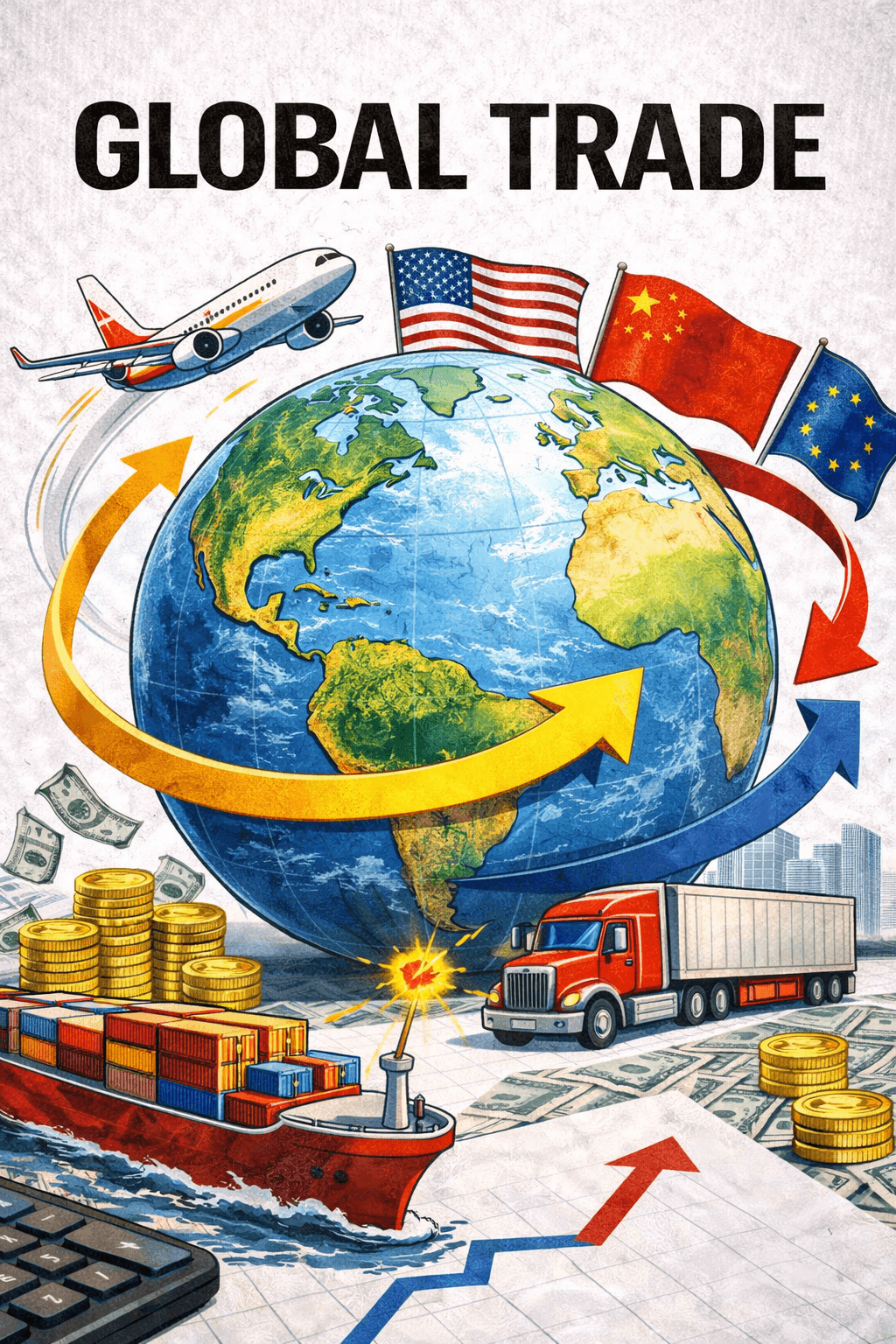
International trade in a globalized economy
The modern world economy is highly integrated, and it is no longer realistic to consider any national economy in isolation. Countries are linked through flows of goods, services, capital, and technology. International trade plays a central role in this integration by allowing countries to specialize, exchange output, and access markets beyond their domestic borders.
The United States has a large and diverse economy with substantial natural resources and a wide range of productive activities. As a result, the U.S. does not depend on international trade to the same extent as many smaller or less diversified economies. Nevertheless, international trade remains highly significant for the U.S. economy. American firms participate actively in global markets, exporting goods and services around the world and importing products that are cheaper or unavailable domestically.
International trade creates opportunities for firms to expand production and reach larger markets. It also allows consumers to access a wider variety of goods and services at lower prices. At the same time, integration into the global economy exposes countries to external shocks. Events such as financial crises, sharp changes in commodity prices, or shifts in global demand can spread rapidly across borders and affect domestic economic conditions.
Understanding international trade therefore requires recognizing both its benefits and its risks, as well as the patterns through which trade flows between countries and regions.
Trade between nations
All countries engage in international trade to some degree. This reflects differences in climate, natural resources, technology, and factor endowments. Some goods can be produced more efficiently in certain locations than in others. For example, agricultural products that require specific climatic conditions may be costly or impossible to produce domestically, making imports the sensible option.
Trade between nations allows countries to consume goods and services that would otherwise be unavailable or prohibitively expensive. It also enables producers to specialize in activities where they are relatively efficient, increasing overall output. This specialization is a key reason why trade can raise living standards.
International trade is not a new phenomenon. Trade has existed for centuries, but its scale and importance expanded dramatically with improvements in transportation and communication. The Industrial Revolution increased the range of manufactured goods available for trade, and technological progress reduced the cost of moving goods across long distances.
The volume of world trade increased significantly after the Second World War, particularly among developed economies. Over time, emerging and developing economies also became more integrated into global trade networks. However, the gains from this expansion have not been evenly distributed across countries or within countries.
Openness to international trade
Countries differ widely in the extent to which they engage in international trade. A common way to measure openness is to calculate total trade, defined as exports plus imports, as a percentage of gross domestic product. This measure indicates how important international trade is relative to the size of the domestic economy.
Some economies have very high trade to GDP ratios. These are often smaller countries with limited domestic markets that rely heavily on trade to obtain goods and services and to sell their output. Other economies have much lower trade to GDP ratios, reflecting either a large domestic market, abundant natural resources, or policy choices that limit engagement with global trade.
The United States has a relatively low trade to GDP ratio compared with many other advanced economies. This reflects the size and diversity of the U.S. economy, which allows a large proportion of goods and services to be produced and consumed domestically. Countries such as Brazil, India, and Pakistan also have relatively low trade dependence, in part due to similar characteristics and, in some cases, long standing policy preferences that emphasize domestic production.
At the other end of the spectrum, some economies pursue highly open trade policies, actively promoting exports as a driver of economic growth. Economies in East and Southeast Asia, for example, have often followed export oriented strategies, integrating deeply into global supply chains in order to expand output and employment.
It is possible for a country’s trade to exceed 100 percent of GDP. This can occur because exports may include goods that incorporate imported components. When such goods are exported, the value of both the imported inputs and the final product are counted, resulting in some double counting.
The pattern of global trade
The pattern of global trade reflects differences in economic size, income levels, and stages of development. Trade flows are dominated by developed economies and large emerging economies, which account for the majority of global exports and imports.
Trade between developed economies remains particularly significant. High income countries tend to trade extensively with one another, exchanging manufactured goods, services, and high value products. These economies have strong purchasing power and well developed infrastructure, making them central to global trade networks.
Emerging economies have become increasingly important participants in international trade. Rapid industrialization and export led growth have allowed some countries to expand their share of global exports at an unprecedented pace. This has altered the direction and composition of world trade flows.
In contrast, many developing economies remain relatively marginal participants in global trade. Despite large populations, some regions contribute a small share of world exports and imports. This reflects lower income levels, limited industrial capacity, and dependence on a narrow range of primary products.
Trade patterns also evolve over time in response to policy decisions and institutional changes. The formation of regional trade agreements, reductions in trade barriers, and deregulation of markets can all influence where countries trade and what they trade.
Regional trade flows and the structure of world trade
The pattern of international trade can be examined by looking at how trade flows are distributed between different regions of the world. These patterns reveal which parts of the global economy are most closely integrated and which remain relatively disconnected from international markets. They also help explain why some countries benefit more from international trade than others.
A striking feature of global trade is the dominance of trade between developed economies and between developed and emerging economies. Regions such as North America, Europe, and parts of Asia account for a large share of both world exports and world imports. This reflects their high levels of income, industrial capacity, and purchasing power.
Trade within regions, known as intraregional trade, is particularly significant in some parts of the world. In regions with strong economic integration and low barriers to trade, countries are more likely to trade with their neighbors. This is partly due to lower transportation costs, shared standards and regulations, and long established supply chains.
Intraregional trade and economic integration
Intraregional trade refers to trade that takes place between countries within the same geographic region. The share of intraregional trade varies considerably across regions. Some regions conduct a large proportion of their trade with neighboring countries, while others rely more heavily on trade with distant partners.
High levels of intraregional trade are often associated with economic integration. When countries reduce trade barriers, harmonize regulations, and improve cross border infrastructure, firms find it easier to source inputs and sell output within the region. This encourages the development of regional supply chains, in which different stages of production are spread across multiple countries.
In North America, intraregional trade has been supported by trade agreements that reduced tariffs and facilitated cross border production. Firms often specialize in particular stages of production, exporting intermediate goods that are used in further processing elsewhere in the region before final products are sold domestically or exported to other parts of the world.
In regions with less integration, intraregional trade tends to be lower. Barriers such as poor infrastructure, political instability, or limited industrial capacity reduce the incentives for firms to trade with neighboring countries. As a result, these regions account for a smaller share of global trade.
Trade between regions and global imbalances
Interregional trade refers to trade flows between different regions of the world. These flows reflect differences in factor endowments, income levels, and patterns of specialization. For example, high income economies tend to import labor intensive goods from lower income economies, while exporting capital intensive and technology intensive products.
Large economies play a disproportionate role in interregional trade. The United States, for example, is both a major importer and exporter, reflecting the size of its domestic market and its integration into global supply chains. Emerging economies with large populations and rapidly growing industrial sectors have also become increasingly important participants in interregional trade.
Trade imbalances can arise when a country consistently imports more than it exports or vice versa. These imbalances are closely linked to differences in savings and investment behavior across countries. While trade imbalances are not inherently harmful, large and persistent imbalances can create economic and political tensions.
Goods versus services in international trade
Much of the discussion of international trade focuses on trade in goods. Manufactured products, agricultural commodities, and raw materials have traditionally dominated trade flows. However, trade in services has become increasingly important, particularly for advanced economies.
Services include activities such as finance, insurance, transportation, education, and professional services. These services are often high value added and rely heavily on skilled labor and technology. The United States is a major exporter of commercial services, reflecting its strong position in sectors such as finance, technology, and business services.
The growth of trade in services reflects changes in the structure of advanced economies, where services account for a large share of output and employment. Advances in communication technology have also made it easier to trade services across borders, further increasing their importance in global trade.
Why countries both export and import similar goods
An apparent puzzle in international trade is that countries often both export and import similar types of goods. For example, a country may export automobiles while also importing automobiles. This pattern is known as intra industry trade.
Intra industry trade arises because goods are differentiated. Products that fall into the same broad category may differ in design, quality, branding, or technology. Consumers value variety, and firms specialize in producing particular versions of a product. Trade allows countries to access a wider range of differentiated goods than could be produced domestically.
Intra industry trade is particularly common among developed economies with similar income levels and production structures. These countries trade extensively with one another, exchanging differentiated manufactured goods and services rather than completely distinct products.
Advantages and disadvantages of international trade
International trade has become an increasingly important feature of the global economy, and its effects differ across countries depending on their level of development, economic structure, and position in global markets. While trade can generate significant benefits, it can also create costs and vulnerabilities. Evaluating international trade therefore requires examining both its advantages and disadvantages, and considering how these vary between developed economies, emerging economies, and developing economies.
Developed economies
For developed economies such as the United States, international trade offers several clear advantages. One major benefit is access to raw materials and natural resources that are not available domestically or that would be costly to produce at home. Even though the U.S. has a wide range of natural resources, it still relies on imports for certain commodities and intermediate inputs that support domestic production.
International trade also increases consumer choice. By importing goods and services from abroad, consumers gain access to a wider variety of products than could be produced domestically. Increased competition from foreign producers can also place downward pressure on prices, improving purchasing power and living standards.
Firms in developed economies benefit from access to larger markets. By exporting goods and services, firms can expand beyond the limits of the domestic market and exploit economies of scale. Producing for global markets allows firms to spread fixed costs over a larger output, reducing average costs and increasing productive efficiency. Exposure to international competition can also encourage firms to innovate, adopt new technologies, and improve management practices.
International trade may also facilitate the transfer of knowledge and technology. Firms that operate in global markets can learn from foreign competitors and collaborators, raising productivity over time. This contributes to long run economic growth by improving the efficiency with which labor and capital are used.
However, international trade also has disadvantages for developed economies. One important concern is increased exposure to external shocks. Because economies are closely linked through trade, disruptions in one part of the world can quickly affect domestic production and employment. Global financial crises, supply chain disruptions, or sudden changes in commodity prices can transmit instability across borders.
Trade can also contribute to structural change that creates adjustment costs. Increased import competition may lead to the decline of certain industries, particularly those that are labor intensive or less competitive. Workers in these industries may experience job losses and face difficulties transitioning to new employment, especially if their skills are not easily transferable. While the economy as a whole may benefit, the gains from trade may be unevenly distributed.
Emerging economies
Emerging economies have often used international trade as a central component of their development strategies. Export oriented growth has allowed many of these economies to industrialize rapidly, increase employment, and raise income levels. By producing goods for global markets, firms in emerging economies can exploit economies of scale that would not be possible if they relied solely on domestic demand.
International trade allows emerging economies to specialize in industries where they have a cost advantage, often due to lower labor costs or rapidly improving productivity. Export earnings provide foreign exchange that can be used to import capital goods, machinery, and technology, supporting further industrial development.
Trade can also accelerate structural transformation. As emerging economies integrate into global markets, labor can move from low productivity activities into higher productivity manufacturing and service sectors. This shift raises average productivity and supports economic growth.
However, reliance on international trade can also create vulnerabilities. Export led growth strategies often depend heavily on external demand. A slowdown in global trade or a recession in major trading partners can reduce export demand, leading to lower growth and rising unemployment. Emerging economies may therefore be more exposed to fluctuations in the global business cycle.
There is also the risk that growth driven by exports may rely on low wages and weak labor protections. While this can make exports competitive, it may limit improvements in living standards and contribute to income inequality. In addition, rapid industrialization can place pressure on the environment if growth is not accompanied by appropriate regulation.
Developing economies
Developing economies are often expected to gain significantly from international trade, but in practice their experience has been mixed. One potential advantage is access to larger markets beyond the small domestic economy. By exporting goods abroad, developing economies can overcome the constraints imposed by limited domestic demand.
International trade can also provide access to capital goods and technology that are essential for development. Imports of machinery and equipment can raise productivity and support the development of new industries. Trade may also encourage the development of skills and expertise as firms learn to meet international standards.
However, many developing economies face significant barriers to realizing these gains. Their exports are often concentrated in primary products such as agricultural goods or raw materials. These products tend to have low value added and are subject to volatile prices. Fluctuations in world commodity prices can lead to unstable export earnings and economic uncertainty.
Dependence on primary product exports can also limit industrial development. If resources are concentrated in extractive or agricultural activities, there may be little incentive or capacity to develop manufacturing industries. This can trap economies in low income activities and slow progress toward higher productivity sectors.
Developing economies may also struggle to compete in global markets due to a lack of infrastructure, limited access to finance, and weaker institutions. Firms in these countries often face competition from large and experienced multinational corporations, making it difficult to gain a foothold in international markets.
Another disadvantage is vulnerability to external shocks. Heavy dependence on exports means that downturns in global demand can have severe domestic consequences. Without diversified economies or strong safety nets, developing countries may experience sharp declines in income and employment during global downturns.
Overall assessment of international trade
International trade offers significant potential benefits, including higher productivity, greater consumer choice, and increased economic growth. However, these benefits are not automatic and are not evenly distributed. The impact of trade depends on a country’s economic structure, level of development, and policy framework.
For developed economies, the challenge lies in managing adjustment costs and ensuring that the gains from trade are widely shared. For emerging economies, the key issue is balancing export led growth with domestic development and resilience. For developing economies, the main difficulty is overcoming structural constraints that limit their ability to benefit fully from trade.
International trade therefore presents both opportunities and challenges. Effective policy requires recognizing these trade offs and designing strategies that maximize the long run benefits while addressing the associated risks.
Changes in trade patterns over time and overall evaluation
The pattern of international trade is not fixed. Trade flows evolve over time as economies grow, technologies change, and policy frameworks shift. Understanding international trade therefore requires not only examining current patterns, but also recognizing the forces that drive change and the consequences of those changes for different groups of countries.
One important factor shaping trade patterns over time is economic growth. As countries grow richer, their demand for goods and services changes. Higher income economies tend to demand a greater variety of manufactured goods and services, while the relative importance of basic primary products declines. This affects both the composition of trade and the direction of trade flows, as countries increasingly exchange differentiated products rather than fundamentally different goods.
Technological progress has also played a major role in reshaping international trade. Improvements in transportation have reduced the cost of moving goods across long distances, while advances in communication technology have made it easier to coordinate production across borders. These changes have encouraged the development of global supply chains, in which different stages of production are located in different countries. As a result, trade now often involves intermediate goods that cross borders multiple times before final products reach consumers.
Policy decisions have been another key driver of changing trade patterns. Reductions in trade barriers, the deregulation of markets, and the formation of trade agreements have increased the volume of trade and altered its direction. When countries choose to open their economies to trade, firms are more likely to integrate into regional and global markets. Conversely, more restrictive trade policies can limit trade flows and reduce international integration.
Changes in economic structure also influence trade. As economies develop, they often move away from agriculture and basic manufacturing toward higher value added manufacturing and services. This shift affects what countries export and import. Advanced economies tend to export services and high technology products, while importing a wide range of consumer goods and intermediate inputs. Emerging economies often experience a rapid expansion of manufacturing exports as they industrialize.
Despite the growth of international trade, its benefits have not been evenly distributed. Some countries and regions have integrated successfully into global markets and experienced rapid growth, while others have remained marginal participants. Within countries, certain industries and workers have benefited from trade, while others have faced job losses and downward pressure on wages. These uneven effects help explain why international trade can be politically controversial, even when it raises overall economic welfare.
International trade also increases exposure to external shocks. Greater integration means that economic disturbances can spread more quickly across borders. A slowdown in global demand, financial instability, or disruptions to supply chains can have significant domestic effects. This vulnerability highlights the importance of diversification and resilience in trade dependent economies.
Overall, international trade plays a central role in shaping modern economies. It enables specialization, increases efficiency, expands consumer choice, and supports economic growth. At the same time, it creates adjustment costs, distributional challenges, and exposure to external risks. The impact of trade depends on a country’s size, level of development, economic structure, and policy choices.
For developed economies such as the United States, the key challenge is managing the distributional effects of trade while maintaining openness to global markets. For emerging economies, international trade remains a powerful engine of growth, but one that must be balanced against vulnerability to global fluctuations. For developing economies, the potential gains from trade exist, but realizing them requires overcoming structural constraints and building the capacity to compete internationally.
International trade is therefore neither an unqualified benefit nor an inherent problem. It is a complex process that brings both opportunities and trade offs. Effective economic policy requires recognizing these realities and designing strategies that allow countries to capture the long run gains from trade while mitigating its costs.

Next Article