
Macroeconomics Chapter 20: Financial Regulation
This chapter explores the concepts of financial regulation and central banking.
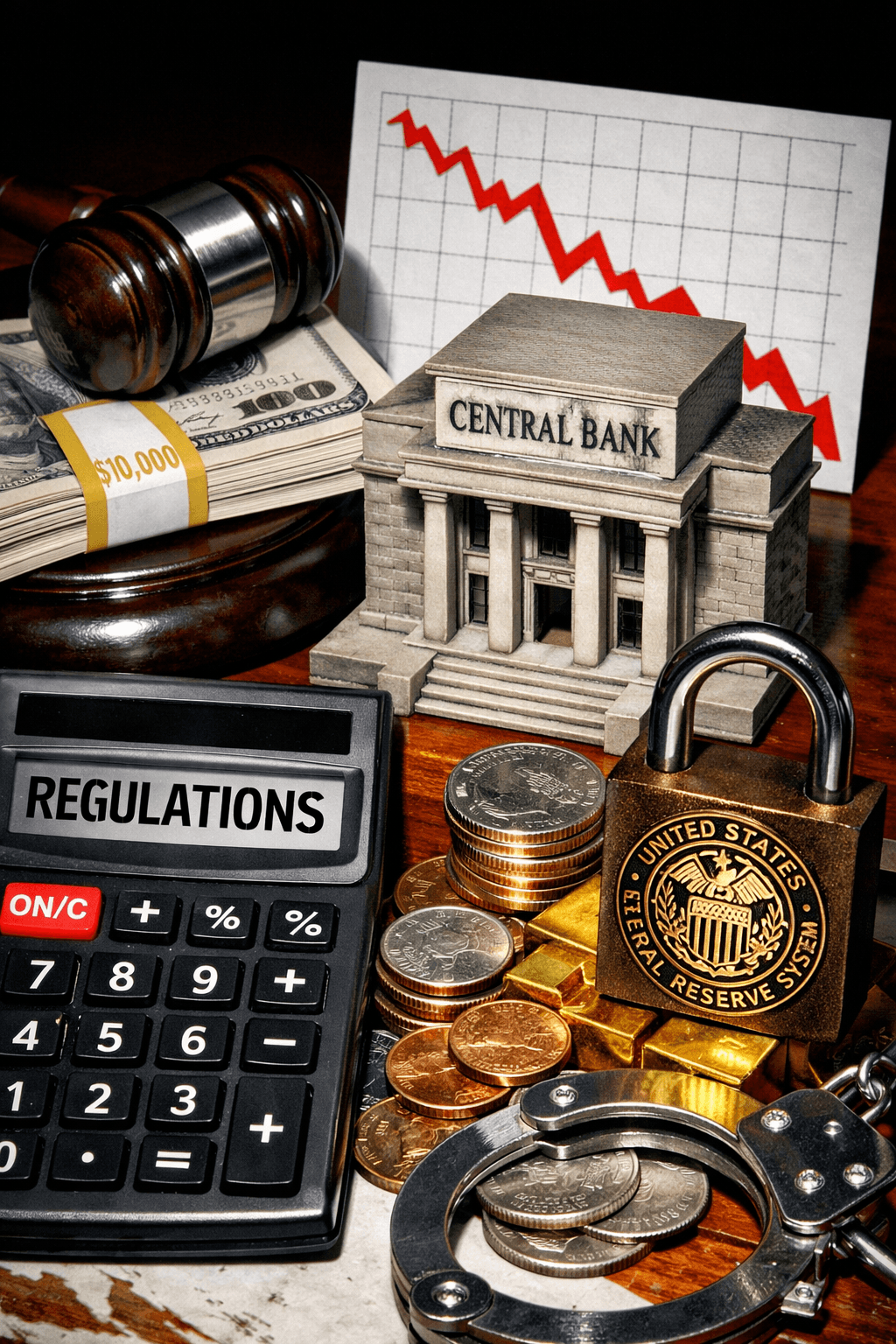
The Central Bank and Financial Regulation
The central bank occupies a central position within the financial system. It is responsible for maintaining stability in both monetary conditions and the financial system as a whole. This includes managing the supply of money and liquidity, influencing interest rates, overseeing financial institutions, and responding to periods of financial stress. In modern economies, the central bank plays a critical role not only in guiding macroeconomic outcomes such as inflation and economic growth, but also in safeguarding confidence in the banking system.
In the United States, these responsibilities are carried out by the Federal Reserve System. The Federal Reserve operates independently from day-to-day political control, but within a framework of objectives established by Congress. This independence is intended to enhance credibility and reduce the risk that short-term political pressures lead to unstable macroeconomic outcomes. Alongside its monetary policy responsibilities, the Federal Reserve has a major role in financial regulation and supervision, particularly following reforms introduced after the global financial crisis.
This chapter examines the functions of the central bank, the rationale for central bank independence, the use of inflation targeting and interest rate policy, and the need for financial regulation. It also evaluates the role of international institutions in maintaining global financial stability.
The functions of the central bank
All developed economies, and most developing economies, have a central bank that performs a range of essential functions. One of the most fundamental responsibilities of the central bank is issuing the national currency. In the United States, the Federal Reserve issues Federal Reserve notes, which serve as legal tender and form the core of the monetary system.
The central bank also acts as banker to the federal government. Government revenues and expenditures are processed through accounts held at the central bank, and the central bank plays a role in the management of government borrowing. While the U.S. Treasury is responsible for issuing Treasury securities, these operations are closely coordinated with the Federal Reserve, particularly because government debt issuance interacts with monetary conditions and liquidity in financial markets.
Another key function is acting as banker to commercial banks and other financial institutions. Commercial banks hold reserve balances at the Federal Reserve, which they use to settle payments between themselves and to meet regulatory reserve requirements. These reserves form an important stock of liquid assets. By managing the level of reserves in the banking system, the central bank influences short-term interest rates and ensures that payments within the financial system can be completed smoothly.
The Federal Reserve also plays a role in managing foreign exchange reserves on behalf of the government, although the U.S. dollar is allowed to float freely in foreign exchange markets. Direct intervention in currency markets has been rare in recent decades, reflecting confidence in market-determined exchange rates and the international role of the dollar.
Beyond these operational roles, the central bank has a broader responsibility for monetary and financial stability. Monetary stability refers to stability in the general price level, meaning low and predictable inflation. Financial stability refers to the efficient flow of funds through the financial system and sustained confidence in financial institutions. These two objectives are closely related, as instability in one can undermine the other.
A traditional role associated with financial stability is that of lender of last resort. This means that the central bank stands ready to provide liquidity to financial institutions that are solvent but experiencing temporary funding difficulties. By doing so, the central bank can prevent liquidity problems from escalating into widespread bank failures. While this role has long been recognized, the scale of central bank intervention during the financial crisis highlighted both its importance and its limitations.
Monetary stability and the role of interest rates
Monetary stability in the United States is defined in terms of price stability and maximum sustainable employment. These objectives are set out in the Federal Reserve’s dual mandate. Price stability is generally interpreted as a low and stable rate of inflation, which allows households and firms to form reliable expectations about the future. Stable inflation reduces uncertainty, encourages long-term planning, and supports economic growth.
The primary tool used by the central bank to influence monetary conditions is the interest rate. In the United States, this is implemented through the federal funds rate, which is the interest rate at which banks lend reserves to each other overnight. By influencing this rate, the Federal Reserve affects a wide range of other interest rates throughout the economy, including those faced by households and firms.
Changes in interest rates influence aggregate demand through several channels. Higher interest rates increase the cost of borrowing, which tends to reduce consumption and investment. Lower interest rates reduce borrowing costs, encouraging spending and investment. Through these mechanisms, the central bank can influence inflationary pressures and economic activity.
Central bank independence and inflation targeting
A significant development in the conduct of monetary policy has been the move toward greater central bank independence. In the United States, the Federal Reserve operates independently in setting monetary policy, even though its objectives are determined by Congress. This independence is intended to enhance the credibility of monetary policy by reducing the risk that governments manipulate interest rates for short-term political gain.
Inflation targeting refers to the practice of committing to a specific inflation objective and using monetary policy tools to achieve it. In the United States, the Federal Reserve has articulated a long-run inflation goal of 2 percent, which it views as consistent with price stability. By clearly communicating this target, the central bank seeks to anchor inflation expectations and improve the effectiveness of monetary policy.
However, inflation targeting involves trade-offs. While focusing on inflation can enhance credibility, it may limit the central bank’s ability to respond to other objectives, such as economic growth or financial stability. As a result, the Federal Reserve emphasizes flexibility, allowing it to respond to economic conditions while maintaining a long-term commitment to price stability.
Financial regulation
In recent decades, rapid advances in financial technology and innovation have transformed the way financial institutions operate. Financial transactions have become faster, more complex, and more interconnected, allowing banks and other financial firms to expand the range of activities they undertake. New financial products have been developed to increase returns and manage risk, but these innovations have also made the financial system more difficult to regulate and supervise.
One consequence of this transformation is that traditional forms of financial regulation struggled to keep pace with changes in financial markets. Regulatory frameworks that were designed for simpler banking systems proved inadequate for overseeing institutions that were highly leveraged, globally interconnected, and engaged in complex financial engineering. As a result, financial institutions were able to take on levels of risk that exceeded what could be absorbed by their capital buffers.
This regulatory failure was a major contributing factor to the global financial crisis. In the period leading up to the crisis, banks expanded lending aggressively, often financing long-term and risky assets with short-term borrowing. When confidence in financial markets collapsed, funding dried up rapidly, exposing the fragility of the system. The inability of regulation to restrain excessive risk-taking allowed vulnerabilities to build up unchecked.
The crisis demonstrated that maintaining monetary stability alone is not sufficient to ensure overall economic stability. Although inflation had remained relatively low and stable prior to the crisis, financial imbalances were growing beneath the surface. This highlighted the need for a regulatory framework that focuses explicitly on financial stability, rather than relying solely on price stability as an indicator of economic health.
Monetary stability and financial stability
Monetary stability refers to stability in the general price level, meaning that inflation is low and predictable. Financial stability refers to the ability of the financial system to allocate resources efficiently, manage risks effectively, and maintain confidence among households and firms. While these two forms of stability are related, they are not the same, and one does not guarantee the other.
A stable price level helps economic agents plan for the future, encouraging investment and consumption decisions that support economic growth. However, the financial crisis demonstrated that even when inflation is stable, the financial system can become dangerously fragile. Excessive credit growth, asset price bubbles, and rising leverage can occur without generating immediate inflationary pressures.
Financial stability requires that there is sufficient liquidity in the system for financial institutions to conduct their operations. Liquidity refers to the ease with which assets can be converted into means of payment without significant loss of value. When liquidity is abundant, banks can meet their obligations and continue lending. When liquidity dries up, even solvent institutions can face serious difficulties.
A traditional mechanism for addressing liquidity shortages is the central bank’s role as lender of last resort. In this role, the central bank provides emergency funding to financial institutions that cannot obtain liquidity elsewhere. By doing so, it can prevent liquidity problems from spreading through the financial system and triggering widespread bank failures. During the financial crisis, the Federal Reserve expanded this role significantly, providing liquidity on an unprecedented scale.
However, reliance on lender-of-last-resort facilities creates potential problems. If banks expect to be rescued during crises, they may take greater risks during normal times. This problem, known as moral hazard, underscores the importance of regulation that limits excessive risk-taking before crises occur.
The response to the financial crisis
The financial crisis underscored the deep connection between the financial system and the real economy. Disruptions to financial markets quickly spilled over into declines in output, rising unemployment, and falling incomes. This experience reinforced the importance of financial stability as a core objective of economic policy.
In the United States, the immediate response to the crisis involved aggressive monetary policy easing and large-scale liquidity provision by the Federal Reserve. Interest rates were reduced to very low levels, and unconventional policies such as large-scale asset purchases were introduced to support financial markets and stimulate economic activity. These measures were intended to restore confidence and prevent a complete collapse of the financial system.
Alongside monetary policy actions, major reforms were introduced to strengthen financial regulation. The aim of these reforms was to reduce the likelihood of future crises by improving oversight, increasing capital requirements, and addressing systemic risks that arise from interconnected financial institutions.
Macroprudential regulation in the United States
A key lesson from the crisis was that regulation focused solely on individual financial institutions is insufficient. Even if each institution appears sound in isolation, the system as a whole can be unstable due to common exposures and interconnections. This led to the development of macroprudential regulation, which focuses on risks to the financial system as a whole.
In the United States, macroprudential oversight is coordinated through institutions such as the Financial Stability Oversight Council. This body is responsible for identifying and monitoring systemic risks and for coordinating regulatory responses across different agencies. Its role reflects the recognition that financial stability requires a system-wide perspective.
Microprudential regulation, by contrast, focuses on the safety and soundness of individual financial institutions. This includes setting standards for capital adequacy, liquidity, and risk management. In the United States, these responsibilities are shared among agencies such as the Federal Reserve, the Office of the Comptroller of the Currency, and the Federal Deposit Insurance Corporation.
Macroprudential tools include countercyclical capital buffers, which require banks to hold additional capital during periods of rapid credit growth. These buffers can be released during downturns, allowing banks to continue lending when the economy is weak. Regulators can also impose additional requirements on specific sectors if they pose heightened risks to financial stability.
The objective of macroprudential regulation is to reduce the buildup of systemic risk and to enhance the resilience of the financial system. By acting early to restrain excessive risk-taking, regulators aim to reduce the severity and frequency of financial crises.
The international context
Financial markets operate on a global scale, and financial instability can spread rapidly across borders. This makes international coordination of financial regulation essential. Globalization has increased the interconnectedness of financial systems, allowing capital to flow more freely but also increasing the potential for contagion.
International institutions play a key role in promoting coordination and stability. The International Monetary Fund provides short-term financial assistance to countries experiencing balance of payments difficulties and plays a central role in monitoring global economic conditions. By imposing policy conditions on its lending, the IMF seeks to restore stability and confidence, although these conditions have been the subject of significant debate.
The World Bank focuses on long-term development by providing funding for projects that promote economic growth and poverty reduction. Unlike the IMF, it is not directly involved in crisis management, but its role in financing development projects can influence financial stability over the long run by supporting stronger institutions and higher incomes.
In response to past crises, international agreements have been developed to harmonize financial regulation across countries. These agreements aim to set minimum standards for bank capital and risk management, reducing the likelihood that weak regulation in one country undermines global stability.
Evaluation of central banking and financial regulation
The experience of the financial crisis demonstrated that central banks must balance multiple objectives. Monetary stability remains essential, but it must be complemented by a strong focus on financial stability. Low and predictable inflation alone is not sufficient to ensure economic stability if financial imbalances are allowed to grow unchecked.
Financial regulation has become more comprehensive and system-focused in response to the crisis. Macroprudential regulation has expanded the scope of oversight beyond individual institutions to the financial system as a whole. While these reforms have strengthened resilience, they also raise concerns about regulatory complexity and potential constraints on financial innovation.
Overall, an effective central bank and a robust regulatory framework are critical for maintaining confidence in the financial system and supporting sustainable economic growth. While regulation cannot eliminate financial risk entirely, it can reduce the likelihood that risks accumulate to destabilizing levels and can help ensure that the financial system supports, rather than undermines, the real economy.
The International Monetary Fund
The International Monetary Fund plays a central role in the international financial system by promoting global monetary stability and providing financial assistance to countries facing balance of payments problems. When a country experiences a deficit on its current or capital account and is unable to finance this deficit through normal market mechanisms, it may seek assistance from the IMF. The purpose of this assistance is to prevent disorderly adjustments that could destabilize both the domestic economy and the wider global financial system.
IMF lending is typically conditional. Countries receiving assistance are required to implement policy measures aimed at restoring macroeconomic stability and improving long-run economic performance. These conditions often include fiscal consolidation, tighter monetary policy, structural reforms, and measures to strengthen financial institutions. The rationale is that financial support without policy adjustment would only postpone necessary reforms and increase future vulnerabilities.
In the twenty-first century, the IMF has expanded its role beyond traditional balance of payments support. It has provided large-scale financial assistance during systemic crises, including support for countries affected by global financial shocks. The IMF has also become increasingly involved in monitoring financial systems and identifying vulnerabilities that could pose risks to global stability.
However, the IMF’s role has been highly controversial. Critics argue that IMF conditions can impose significant short-term economic costs, including higher unemployment, reduced public spending, and slower growth. There is also concern that policy prescriptions may not adequately reflect the institutional and social context of individual countries. Supporters argue that while adjustment is painful, it is necessary to restore credibility and prevent deeper crises.
The World Bank
The World Bank differs from the IMF in both purpose and time horizon. Its primary role is to promote long-term economic development by providing funding for projects that raise productive capacity and improve living standards. These projects include investments in infrastructure, education, healthcare, agriculture, and institutional development.
The World Bank is particularly important for developing countries with limited access to international capital markets. By providing long-term loans and grants at relatively low interest rates, it helps finance investments that might otherwise be unaffordable. These investments aim to address structural barriers to growth, such as inadequate infrastructure, weak human capital, and limited access to finance.
In addition to providing funding, the World Bank conducts research and offers technical assistance to help countries design effective development policies. Its influence extends beyond finance, shaping debates on poverty reduction, governance, and inclusive growth. In recent decades, the World Bank has placed increasing emphasis on reducing extreme poverty and promoting shared prosperity.
Despite these contributions, the World Bank has also faced criticism. Some argue that its projects have not always delivered promised outcomes or have failed to adequately consider environmental and social impacts. Others contend that development strategies promoted by the Bank have sometimes prioritized market reforms at the expense of social protection. In response, the World Bank has adapted its approach, placing greater emphasis on sustainability, institutional quality, and country-specific development strategies.
Evaluation of the IMF and the World Bank
The IMF and the World Bank play complementary roles within the global financial architecture. The IMF focuses on short-term macroeconomic stability and crisis management, while the World Bank emphasizes long-term development and structural transformation. Together, they aim to support both financial stability and economic growth at the global level.
Their effectiveness depends critically on the design and implementation of their policies. When financial assistance is combined with appropriate reforms and supported by strong domestic institutions, it can help countries restore stability and lay the foundations for sustained growth. However, when conditions are poorly tailored or implemented too rigidly, they may exacerbate economic hardship and undermine public support for reform.
Globalization has increased the importance of these institutions by deepening financial interdependence between countries. Financial crises can now spread rapidly across borders, making international coordination essential. The IMF and the World Bank provide forums for cooperation and mechanisms for managing crises that individual countries cannot address alone.
Overall, while neither institution offers a complete solution to financial instability or development challenges, both play an essential role in supporting the functioning of the global financial system. Their continued relevance depends on their ability to adapt to changing economic conditions and to balance stability, growth, and social outcomes effectively.