
Novartis’ $2B Excellergy bet secures its current immunology portfolio while gambling on the future returns of a still-developing drug.
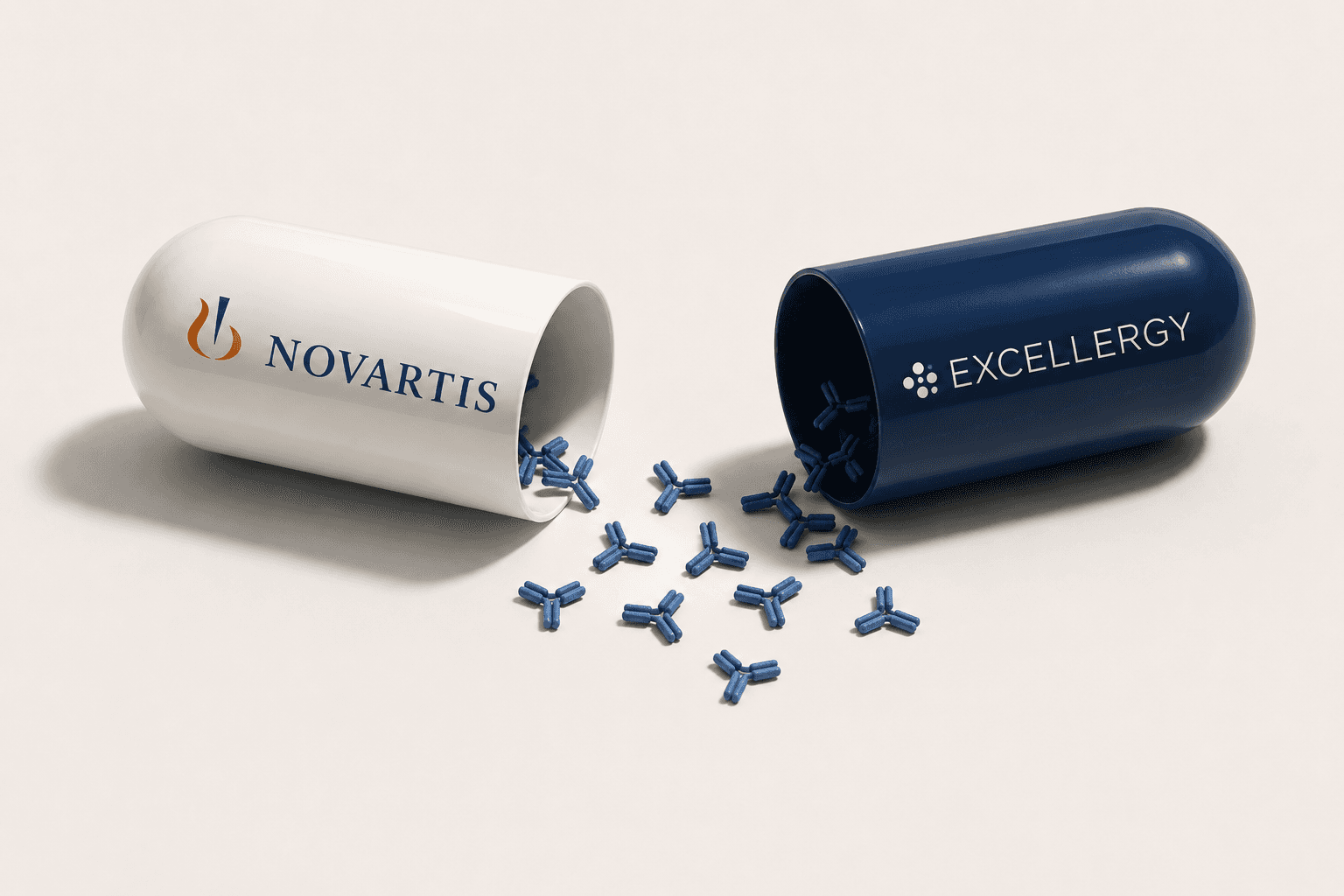
Announced as a milestone-based acquisition, Novartis’ purchase of Excellergy gives the company exposure to a next-generation IgE-targeting platform in a disease area it already understands. Novartis’ own IgE-focused drug—Xolair—treats moderate to severe allergy symptoms, including asthma, chronic hives, nasal polyps, and IgE-mediated food allergies. Xolair remains a major allergy asset, generating $1.7B for Novartis in 2025 and significant additional sales through Roche/Genentech in the U.S. IgE is the antibody that helps trigger allergic reactions by activating mast cells and basophils, immune cells that release histamines and drive inflammation. Xolair works by binding free IgE in the bloodstream before it attaches to these immune cells.
Novartis looks to expand its IgE portfolio with the acquisition of Excellergy, which focuses on next-generation immunology targeting. Because Exl-111 is in phase-1 trials, the acquisition is positional rather than immediately profitable: Novartis is paying now for a drug that still must clear clinical, regulatory, and commercial hurdles before generating revenue.
However, the technology is potentially more effective: while still binding free IgE antibodies, like Xolair, Exl-111 also actively binds to bound IgE on mast cells and basophils and dislodges them from the receptor. Preclinical studies (in monkeys) have shown more than 99% removal of receptor-bound IgE from basophils, but Exl-111 still needs to prove safety, efficacy, and durability in human trials. Excellergy’s advanced Exl-111 appears promising and could succeed Xolair as Novartis’ next big IgE drug.
Exl-111 must still clear clinical trials, broader safety and efficacy studies, regulatory approval, commercial launch, and doctor/payer adoption. Although preclinical studies appear strong, the results do not guarantee Exl-111’s commercial success; it must prove meaningfully better than Xolair or other allergy/immunology treatments to justify commercial adoption. The deal structure helps control some of this risk. Novartis has agreed to pay up to $2 billion in upfront and milestone payments, meaning full headline value likely depends on Excellergy hitting these future development, regulatory, or commercial targets. This limits Novartis’ immediate financial exposure but also highlights the asset's risk and uncertainty. Milestones can reduce the cash risk, but they cannot remove critical development risk; Ex1-111 remains an unproven drug.
For Novartis, the deal is ultimately a bet on optionality. If Ex-11 works, the company gains a possible next-generation successor to Xolair that could dominate the IgE treatment industry, strengthening its control over the industry. If it fails, Novartis voids much of its deal tied to milestone payments, but loses time, energy, and R&D resources on a drug that was never delivered. Novartis’ acquisition of Excellergy presents an opportunity to expand its immunology portfolio, while acquiring a potential competitor and strengthening its control. However, until the platform proves itself in trials and reaches patients, the $2 billion deal remains a bet on future revenue rather than a source of growth today.
Next Article

Related Topics