
Synopsys’ $35B acquisition of ANSYS is more than a software merger; it’s a bid to control the full lifecycle of digital product design. By combining chip design with simulation and AI-driven optimization, the deal could accelerate innovation worldwide.
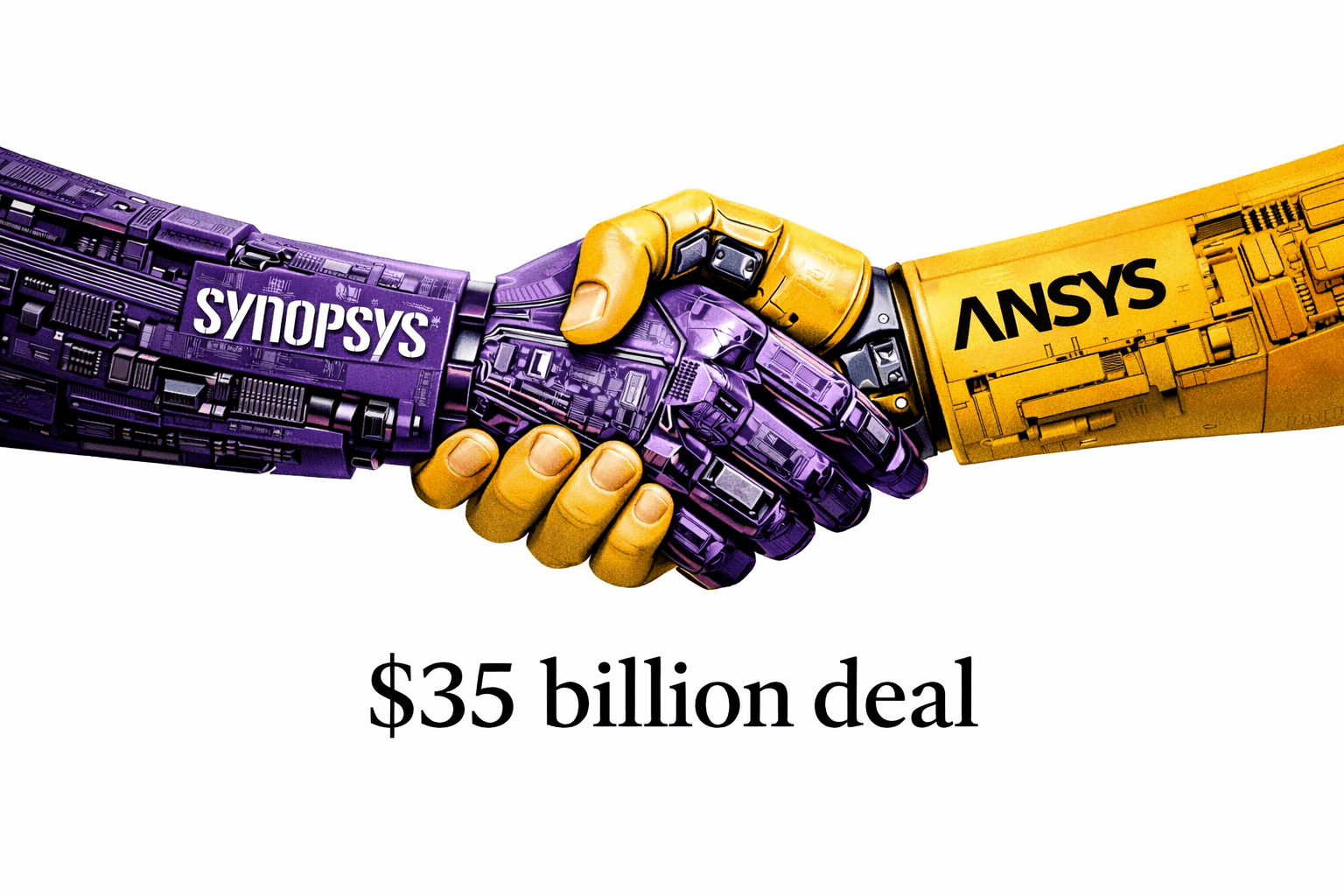
In July 2025, Synopsys completed a $35 billion deal, marking one of the largest software deals in engineering history. The merger brings together Synopsys, a leader in electronic design, and a dominant player in engineering software ANSYS, allowing engineers to design and test products within a single platform. While initially framed as a strategic expansion into simulation, the deal is an arms race of who will have the bigger market share in digital infrastructure and modern product development. The deal seems straightforward, Synopsys dominates electronic design automation (EDA), providing the software for the semiconductor and the chip design. Meanwhile, ANSYS, dominates in engineering simulation software, helping engineers virtually test product for performance in real world conditions, in fields like mechanical, thermal or electromagnetic. Together, they create a vertically integrated company, in which they can design core technology and virtually test how it performs, in one system. Still, the true consequences of the merger go beyond operational overlap.
Before the acquisitions, Synopsys was already a dominant player accounting for 31% of global EDA revenues. Which is similar to its rival Cadence at around 30% and Siemens around 13%. At the same time, ANSYS held a leading position in engineering stimulation of around 40% market share. Combined, they can now control a significant share of engineering software market. By acquiring ANSYS, Synopsys is positioning itself at the intersection of hardware design and AI driven optimization. The merged firm can control how products are created from the earliest stages. This is critical in the age of digital twins, where simulation models are updated throughout a product’s lifecycle. Control over these models is more likely to make customers use the same software for years, creating long term and steady revenue for the company. Beyond market power, the acquisition significantly expands Synopsys’ growth opportunity. The estimate of the combined company’s total addressable market (TAM) is $31 billion. The financial impact of the deal was almost immediate. In the fiscal year 2025, Synopsys reported record revenue of roughly $7.05 billion. A 15% increase from the previous years. Of that, ANSYS contributed around $756.6 million in full year revenue and $667.7 million in the final quarter alone. These numbers show that simulation is not just strategic move, but a major revenue driver within Synopsys’ portfolio. However, the growth comes with a high financial risk. To finance the $35 billion acquisition, the company took a significant long-term debt of over $14 billion in July 31, 2025 compared to their long-term debt of roughly $15 million in 2024, which significantly increased its interest payments. While Synopsys continues to generate strong cash flow, the success of the acquisitions depends on the sustained growth in ANSYS revenues.
This deal signals that simulation has become the gatekeeper of innovation. As products grow more complex, they come with increased costs of physically prototyping and slower time. Advanced technology, such as semiconductors, require an enormous number of tests before anything is built. Simulation is where design decision is validated and optimized. So, what does this mean for innovation? On one hand, integration could accelerate the process and cut cost, allowing them to identify trade-offs early on and design more efficiently. On top of that, generative AI models may enable more accurate predicting capabilities, especially as it can propose designs rather than merely evaluating them. On the other hand, this merger can significantly shrink the innovation field. Engineering simulation is a highly specialized market, in which real breakthrough is driven by small independent firms. A giant company with large market power may prioritize small improvement and selling more products rather than big risks. This leads to customers having fewer choices, less bargaining power, and higher switching costs. Smaller competitors may struggle to match the scale and data access of the combined firms. While, rival firms like Cadence, Siemens or Dassault Système may pursue acquisitions of their own, reinforcing a broader trend towards mergers in engineering software. The result of this is an industry dominated by monopolies. The main concern here is not that innovation will stop, but that it will be concentrated in the hands of larger players, shaping progress on their goals rather than diverse field of competitors. In response to this, there has been antitrust concerns which is why regulators such as the US FTC required divestitures of certain simulation and optical design tools (Keysight Technologies and PowerArtist) to preserve competition.
Perhaps, the most consequential aspect of the deal lies in artificial intelligence. Simulation software generates vast amounts of high-quality physics-based data, which is exactly what AI models require to move beyond pattern recognition. Thus, the merger gains a significant advantage in training AI systems that can predict and eventually automate engineering decisions. In that sense, the acquisition is not just about today’s software revenues but shaping how future engineering decision are made.
Looking ahead, the Synopsys and ANSYS deal is unlikely to be an outlier. It is a leading indicator of where the industry is headed. The future of product design will increasingly occur in simulation before anything physical is built. Whether this future delivers broader innovation or control will depend on how the future of mergers and AI technologies unfold. While there are worries about this merger limiting competition and increasing long term concentration risk, the merger expands the addressable market rather than simply reallocating demand.