
In a single year, Qualcomm completed six acquisitions across AI and semiconductor infrastructure. The message is clear: as its traditional modem business faces long-term erosion, Qualcomm is racing to transform itself from a communications specialist into a fully integrated AI platform company.
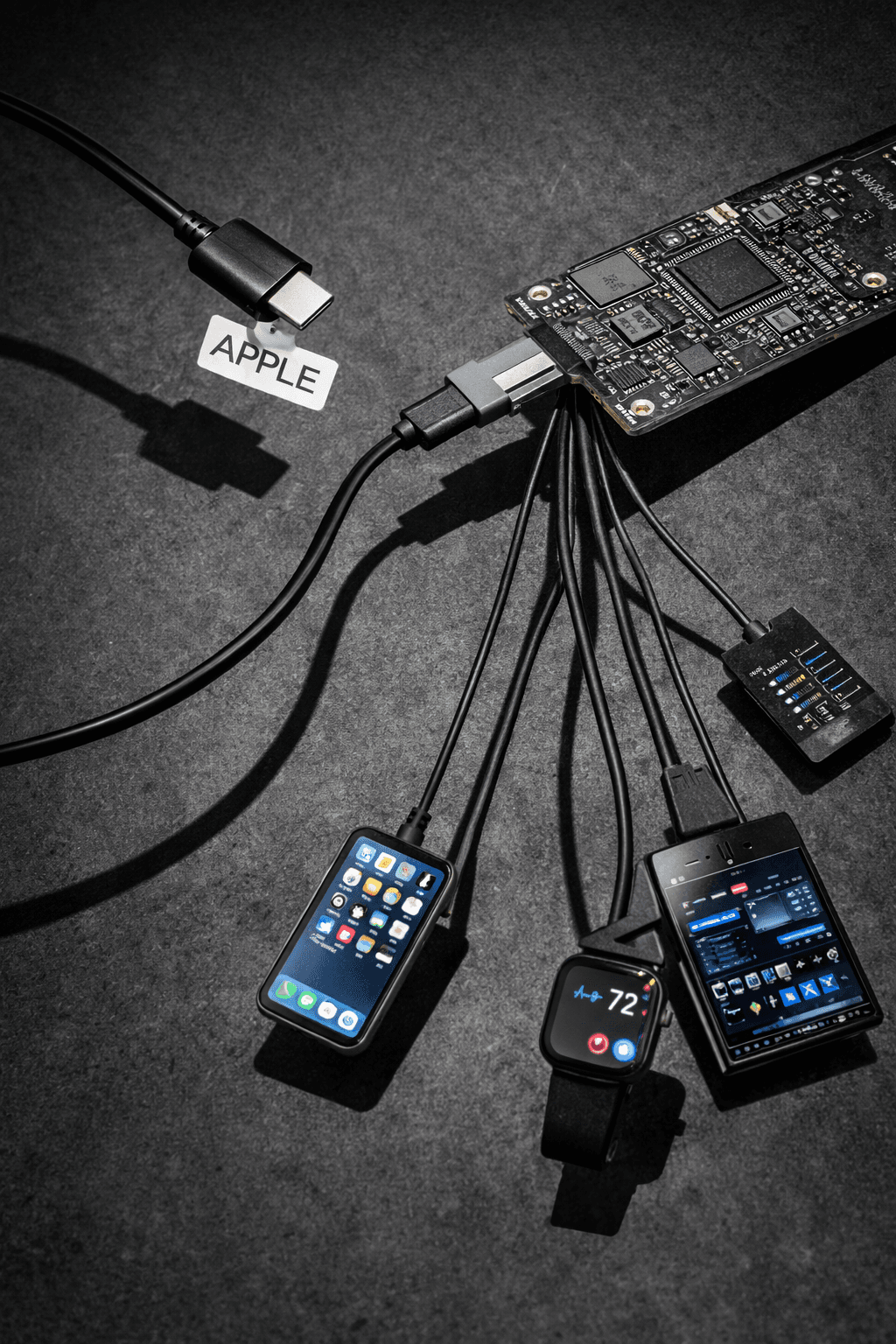
2025 was a big year for corporate acquisitions across the board, but one company in particular made not one but six significant acquisitions in the past year. Qualcomm is responsible for much of the wireless technology and semiconductor chips powering essential functions of everyday devices, from androids to personal computers to gaming consoles. Its name originated from the phrase “quality communications,” and for much of this century, that has primarily entailed these devices.
In fact, Qualcomm has historically relied on two major customers for most of its revenue—Samsung and Apple—mirroring its leadership in 5G technology and its predecessors, and this strategy has worked for the better part of two decades. However, Apple recently announced plans to begin making all of its modems in-house by 2028. As Qualcomm’s current contract with Apple expires at that time, Qualcomm is set to lose seven billion dollars in annual revenue from Apple. This is about 15% of its current revenue. Between this and a significant one-time tax liability paid to the US government in the latest fiscal cycle, investors have been skeptical about Qualcomm’s future earnings and the firm’s stock has taken a hit over the past year.
But communication today is encompasses more devices than we realize: wearable technology, autonomous vehicles, home security devices, and so much more, and communication that does not take advantage of the growing beast known as artificial intelligence is lagging behind. Thus, last year, Qualcomm honed in on exploring inorganic ways to expand its product offerings and strengthen its existing products to provide full-stack edge-AI solutions for various applications.
The first of these acquisitions targeted the enhancement of Qualcomm’s internet of things (IoT) and edge artificial intelligence (AI) capabilities, where edge AI refers to the running of AI directly on local devices as opposed to on a cloud. Locally operating AIs are faster and provide more real-time data, and are more important for devices where the primary goal is not communication with other devices but operating within itself. By acquiring Edge Impulse in March, Qualcomm gained access to its no-code model training and deployment platform, which it has implemented in its Dragonwing processors.
In April, Qualcomm acquired MovianAI (VinAI’s generative artificial intelligence research and application division), enabling Qualcomm to fill a previous gap in its AI offerings. While Qualcomm has invested in internal AI development for years, it has focused on niche applications of AI, like on-device AI. However, with the surge in genAI growth from key players, Qualcomm needed to decide between building its own generative AI model and acquiring one, and it chose the latter.
Two months later, Qualcomm announced the acquisition of Autotalks. This pushes Qualcomm toward increasing its offerings to a new and growing sector: autonomous vehicles. Autotalks enables vehicle-to-everything (V2X) communication, which makes it an incredible complement to the Edge Impulse acquisition. Qualcomm had already been investing in V2X technology, but bringing on Autotalks with its full-fledged technology will accelerate deployment of the technology.
During the same week as the Autotalks acquisition, Qualcomm announced the acquisition of Alphawave Semi for about 2.4 billion dollars. This was an overdue strategic decision to extend Qualcomm’s focus into AI infrastructure capabilities. The semiconductor chips produced by Alphawave Semi serve as the backbone enabling high speed connectivity for data centers, AI, and more, as are the chips produced in-house by many competitors of Qualcomm. Without this acquisition, other upcoming advancements by Qualcomm would not be as impactful as they would either be missing a key component or relying on an outside source.
Then, in October, Qualcomm announced its acquisition of Arduino. This aligns further with Qualcomm’s aim to diversify its customer base by embedding Qualcomm technology, which has historically been used primarily by large enterprises, into the Arduino interface, a beginner-friendly option for students, hobbyists, and other more novice developers. Introducing Qualcomm technology to Arduino’s user base early in their production lifecycles helps Qualcomm to power new developments from their prototype stage to their delivery stage.
And most recently, in December, Qualcomm acquired Ventana Micro Systems. This move equips Qualcomm to design CPUs more specific to its AI endeavors without relying on an external company. While Qualcomm still relies heavily on CPUs from semiconductor firm Arm, especially because of how widely compatible the firm’s CPUs are with existing operating systems, the acquisition of Ventana Micro Systems provides Qualcomm a pathway to decrease its reliance on Arm in the long run, saving it hundreds of millions of dollars annually. Even if Qualcomm continues using Arm, the diversification of suppliers and vertical integration are essential for it to continue being a key player in the space.
In December, Qualcomm also announced the acquisition of another semiconductor company Augentix, but this acquisition did not close until January, signaling that Qualcomm might not be done with acquisitions for the near future.
It is certainly not unusual for large companies like Qualcomm to acquire companies that offer complementary products if the firm believes the products could generate significant returns and the cost (monetary and time) of building the product in-house is higher. Qualcomm itself has acquired over fifty companies over the past fifteen years, with seven in 2014 and 2021.
But why is Qualcomm investing so much in acquisitions now? Each of these companies complement each other and Qualcomm’s existing product offerings to create a more diversified company. While these acquisitions aren’t going to keep Apple reliant on Qualcomm modems, they will enable Qualcomm to diversify its product portfolio and enter new and emerging markets, driving future growth.
Together, these acquisitions reflect the beginning of a new era for Qualcomm, where it is no longer centered solely around communications but working toward becoming a fully vertically-integrated AI provider for all types of technologies. Qualcomm is not just investing in its future; it is investing in the future, and it is betting on becoming a leader in all of these new subsectors of technology, just as it has been in modem technology.